
What Is WDM? A Guide to Wavelength Division Multiplexing
Need more bandwidth without the cost of new fiber? What is WDM? Wavelength Division Multiplexing transmits multiple data streams over one fiber using different light wavelengths. Explore its mechanics and applications with Axclusive below.
What is WDM?
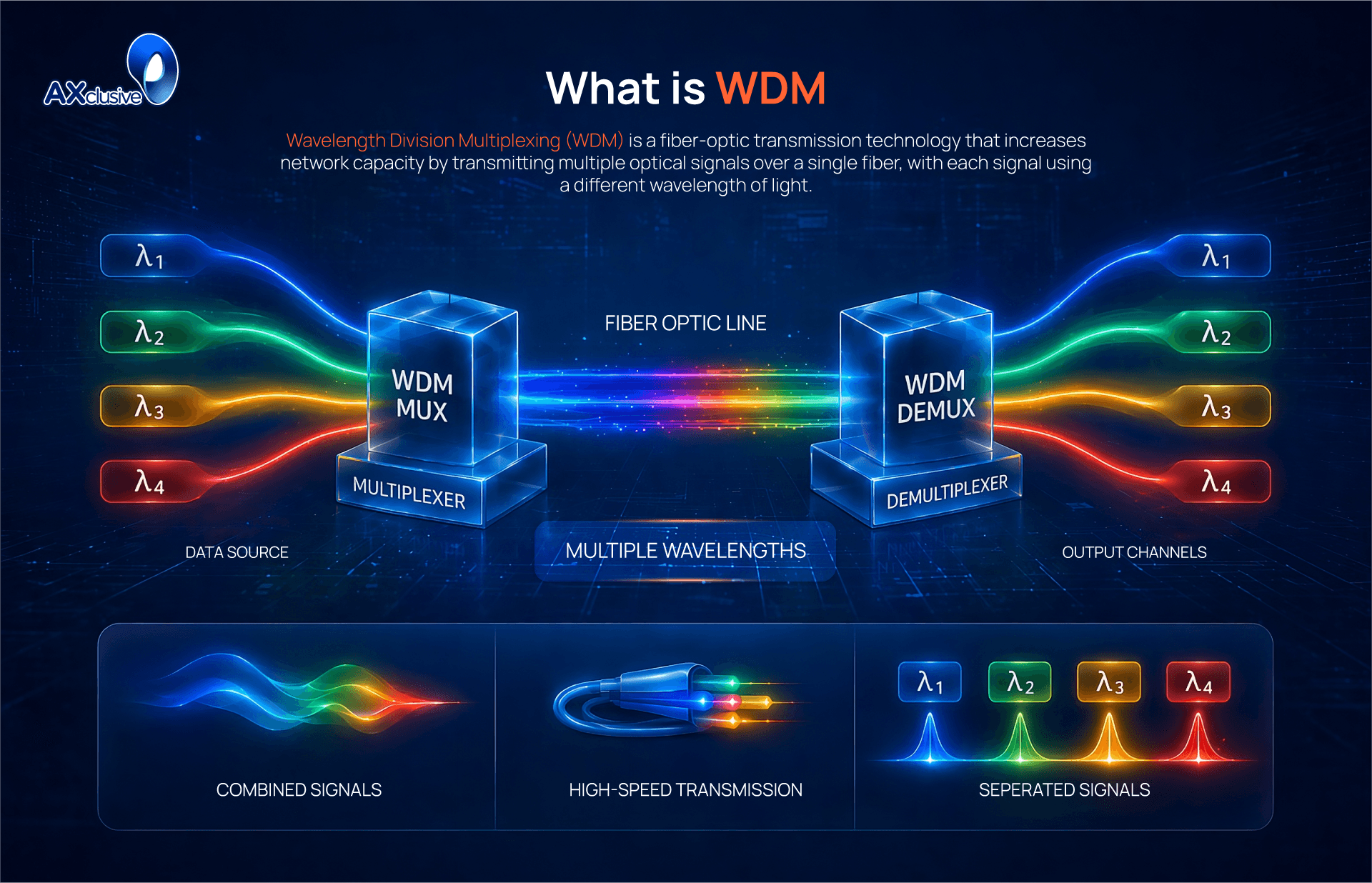
WDM is an optical networking technology that increases the capacity of a single fiber by carrying multiple data signals on different wavelengths of light at the same time. It uses multiplexing to combine multiple optical channels for transmission and separates them again at the destination. This allows network operators to maximize existing fiber capacity, support higher bandwidth, and scale network infrastructure without installing additional fiber cables.
Main Types of WDM Technology
WDM technology is generally divided into two main types, Coarse Wavelength Division Multiplexing (CWDM) and Dense Wavelength Division Multiplexing (DWDM). Both technologies allow multiple optical signals to share a single fiber, but they differ in channel spacing, capacity, transmission distance, and network requirements.
- Coarse Wavelength Division Multiplexing CWDM: CWDM uses wider spacing between wavelengths, allowing multiple optical channels to operate across a broad wavelength range. Its simpler optical requirements make CWDM a practical and cost-efficient solution for shorter-distance networks where extremely high fiber capacity is not required. It is commonly used for metro networks, enterprise connectivity, and access applications.
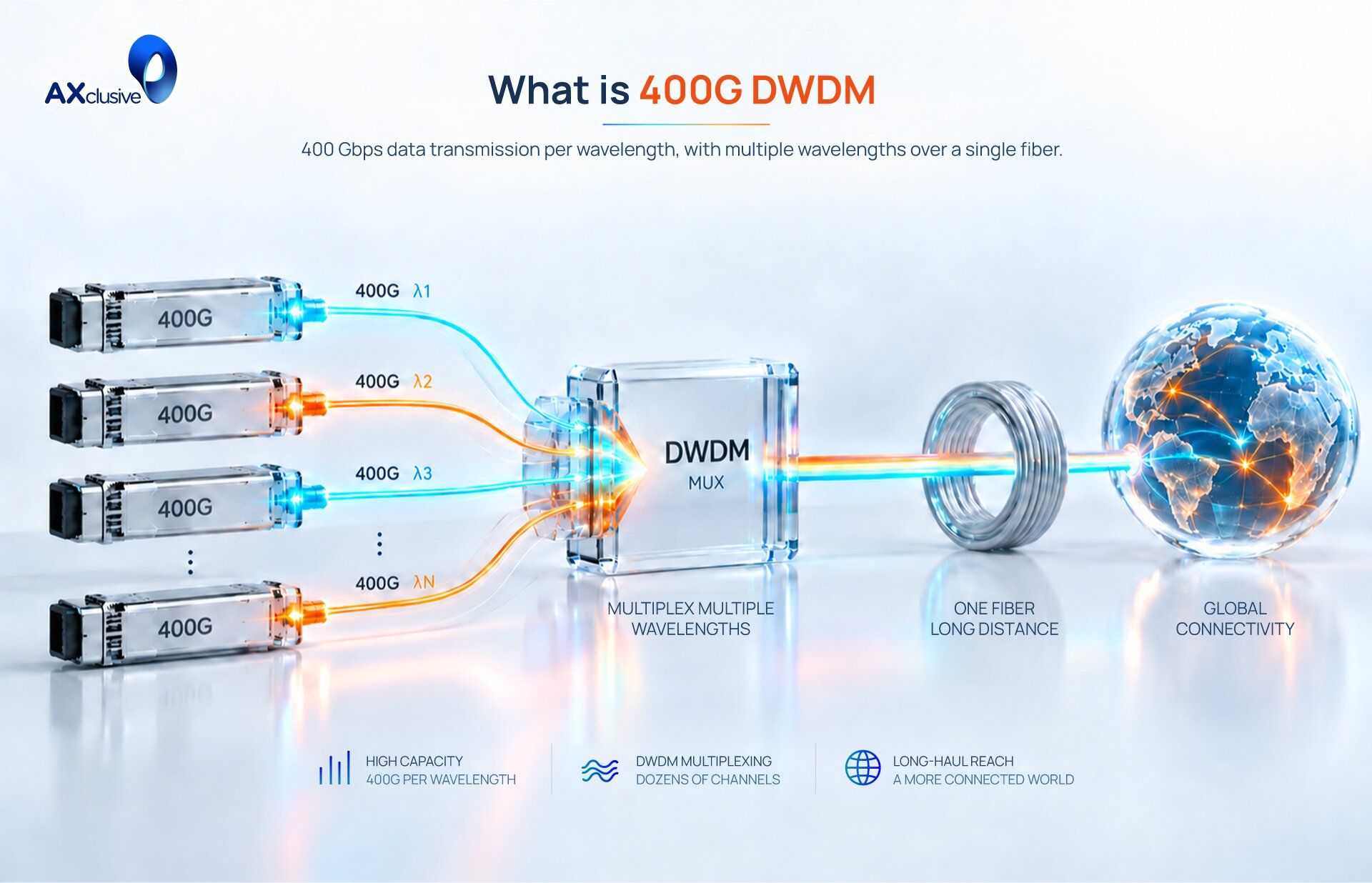
- Dense Wavelength Division Multiplexing DWDM: DWDM uses much narrower channel spacing, enabling significantly more wavelengths to be transmitted over the same optical fiber. This provides higher capacity and better spectrum utilization, making DWDM suitable for high-bandwidth, long-distance, data center interconnection, and carrier-grade optical networks. It can also work with optical amplification to extend transmission across longer distances.
Key Benefits of WDM in Optical Networks
WDM helps network operators increase fiber capacity, support long-distance connectivity, and scale optical networks more efficiently.
- Higher Network Capacity: WDM carries multiple data channels over a single fiber, supporting high-bandwidth connections such as 100G and 400G.
- Extended Transmission Distance: Optical amplifiers such as EDFA can strengthen WDM signals, enabling reliable transmission across longer fiber routes.
- Efficient Fiber Utilization: Multiple wavelengths operate independently on the same fiber, allowing existing infrastructure to carry more traffic without deploying additional fiber.
- Flexible Network Expansion: New wavelengths can be added as bandwidth demand increases. Technologies such as DWDM and ROADM also provide greater flexibility for expanding optical networks.
- Simplified Network Management: Modern WDM systems support centralized monitoring and remote configuration, helping operators provision services and resolve network issues more efficiently.
Single Fiber vs Dual Fiber WDM Systems
WDM networks can use either single fiber or dual fiber transmission. The main difference is how optical signals are sent and received between network locations.
- Single Fiber WDM: Single fiber WDM enables bidirectional transmission over one optical fiber. Different wavelengths are assigned to upstream and downstream traffic, allowing data to travel in both directions while sharing the same physical fiber.This approach helps reduce fiber usage and is useful when available fiber infrastructure is limited.
- Dual Fiber WDM: Dual fiber WDM uses two optical fibers, typically with one fiber carrying transmitted traffic and the other carrying received traffic. The same wavelength can therefore be used in both directions on separate fibers. This configuration provides straightforward network design and is commonly used when sufficient fiber capacity is available.
Essential Components of a WDM System
A WDM system combines several optical components to transmit multiple wavelength channels efficiently over fiber infrastructure. The main components include:
- WDM Multiplexer and Demultiplexer: A WDM Mux/Demux combines multiple wavelength channels onto a single fiber for transmission and separates them back into individual channels at the receiving end. It is a core component in both CWDM and DWDM networks.
- Optical Transceivers: WDM transceivers convert electrical data from network equipment into optical signals at specific wavelengths. Each wavelength can carry an independent data stream across the fiber network.
- Fiber Patch Cords: Fiber patch cords connect transceivers, Mux/Demux devices, and other optical equipment. They provide the physical connections required for signals to move between components within the WDM system.
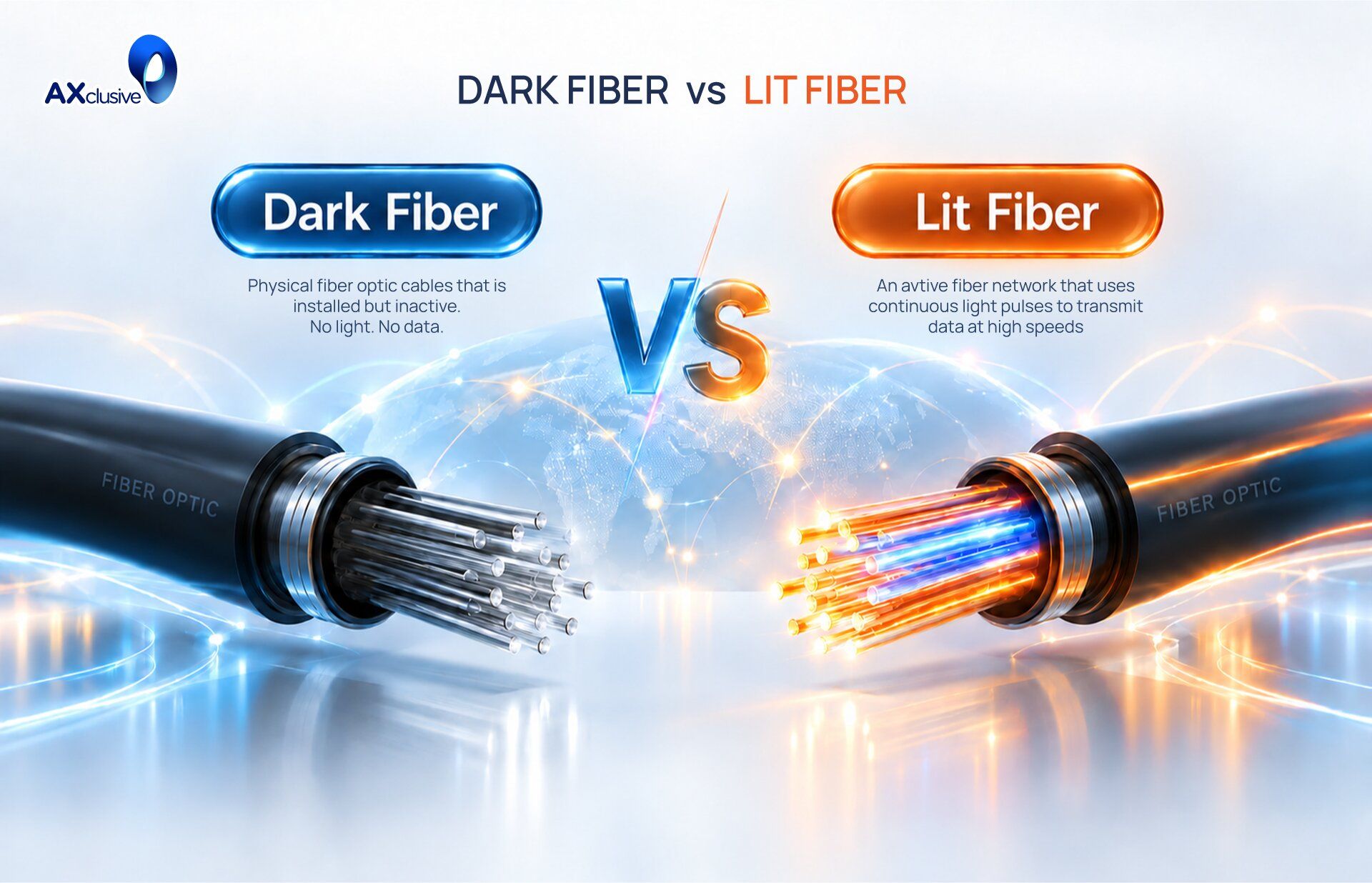
- Dark Fiber: Dark fiber provides the physical transmission path for WDM traffic. By deploying multiple wavelengths over available fiber, network operators can significantly increase capacity without installing new fiber for every connection.
- Supporting Optical Equipment: Depending on network distance and architecture, WDM systems may also use OADMs, ROADMs, optical amplifiers, EDFAs, transponders, and other optical components to extend transmission distance, manage wavelengths, and improve network flexibility.
Common WDM Network Topologies
WDM networks can be designed using different topologies depending on transmission distance, capacity, scalability, and redundancy requirements. The most common configurations include:
- Point-to-Point WDM: Point-to-point WDM creates a direct optical connection between two locations. It is commonly used for data center interconnects, enterprise sites, and long-distance links that require high-capacity and reliable transmission.
- Ring WDM: Ring WDM connects multiple network locations through a circular optical path. Technologies such as OADM or ROADM allow selected wavelengths to be added or removed at individual nodes, making this topology suitable for metro and multi-site networks.
- Mesh WDM: Mesh WDM provides multiple optical paths between network nodes, offering greater routing flexibility and resilience. Traffic can use alternative routes when a connection is disrupted, making mesh designs suitable for large-scale carrier and backbone networks.
- Hybrid WDM: Hybrid WDM combines point-to-point, ring, and mesh architectures within the same network. This approach allows operators to adapt the topology to different locations while balancing capacity, redundancy, and scalability.
WDM remains the primary method for expanding fiber capacity. Understanding what is WDM allows you to optimize bandwidth without laying new cables. This technology supports high capacity peering and data transit across your infrastructure. Axclusive provides the insights needed to manage your optical environment. Secure your network capacity for growth by implementing these practical WDM solutions today.
What is WDM and how it improves bandwidth efficiency in modern fiber networks. Contact us to build scalable, high-performance optical connectivity solutions.