
Dark Fiber vs Lit Fiber for Modern Enterprise Connectivity
Choosing the best fiber optic solution for your company dictates how your entire digital infrastructure will operate. The core difference in the dark fiber vs lit fiber comparison is ownership. You either rent raw cables to build your own private network, or you pay a provider for a fully managed internet service. Join Axclusive ISP in the article below to quickly learn exactly how these two technologies differ.
What is Lit Fiber?
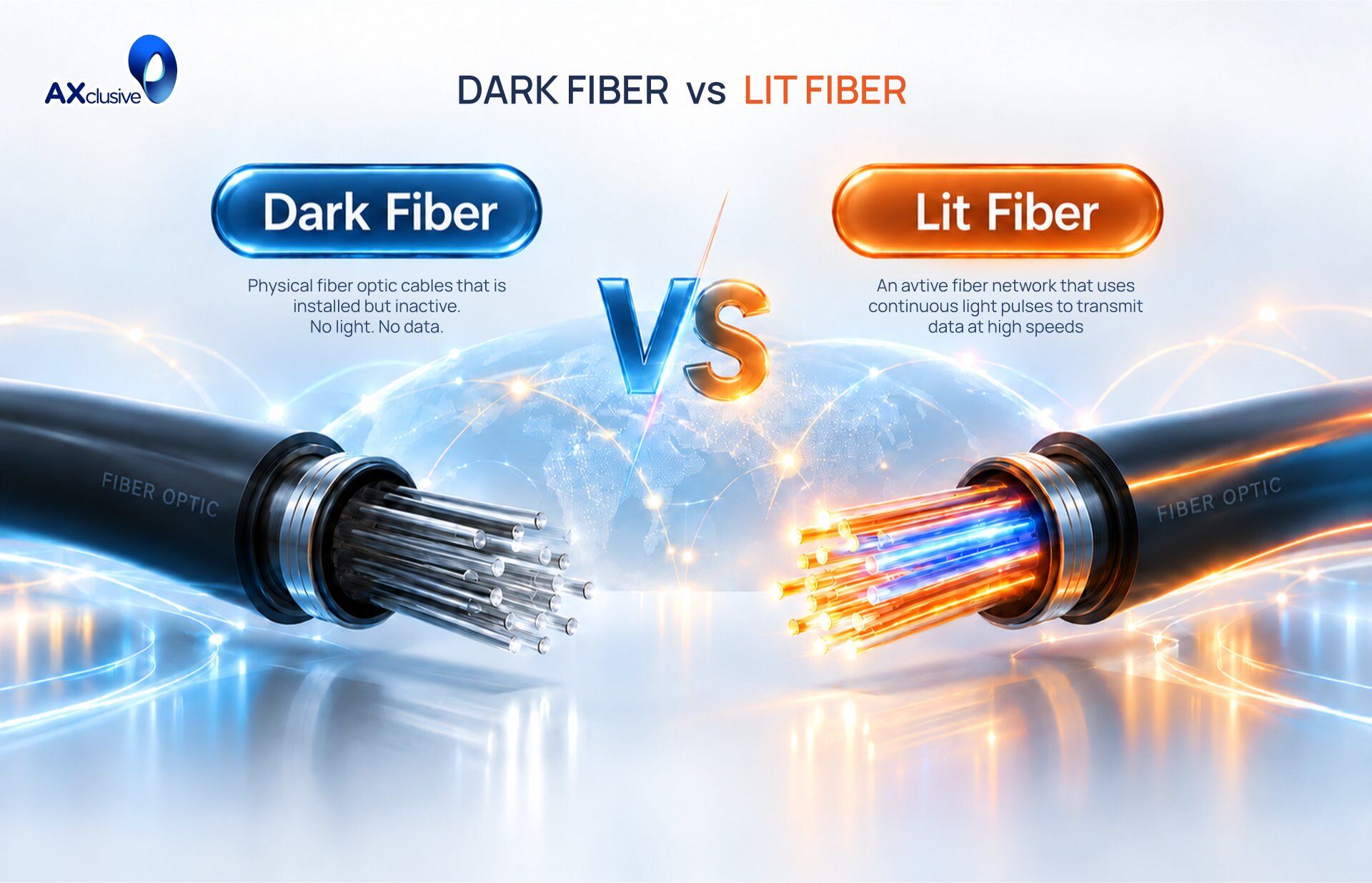
Lit fiber refers to an active fiber optic network that uses continuous light pulses to transmit information at incredibly high speeds. Unlike older copper cables that rely on much slower electrical signals, this modern infrastructure easily supports data heavy cloud applications and massive file transfers.
The defining characteristic of this setup is that a commercial Internet Service Provider fully manages it. The provider supplies the physical glass cables, installs the necessary routing equipment, and actively maintains the connection.
By choosing this fully managed service, businesses unlock several key advantages:
- Ultimate Convenience: Internal IT teams do not need to worry about complex network troubleshooting. The provider handles all backend operations, allowing your company to focus entirely on daily business tasks.
- Reliable Bandwidth Capacity: It delivers massive data capacity immediately. This makes it an ideal solution for organizations with well defined bandwidth needs that do not require constant or sudden capacity upgrades.
- Reduced Administrative Costs: Because the internet provider owns, operates, and maintains the physical equipment, your business saves a significant amount of money on hardware purchases and dedicated technical staff.
What is Dark Fiber?
Dark fiber refers to physical fiber optic cables that have been laid underground but remain completely inactive. Unlike managed services, these glass strands have no light passing through them and no internet traffic running on them.
Instead of buying a standard internet package, a business simply leases this unlit physical infrastructure. The leasing company must then purchase, install, and manage their own routing equipment to light the fiber themselves. This approach turns the business into its own Internet Service Provider, offering unmatched control over the network.
Leasing this inactive infrastructure provides massive operational advantages for large enterprises:
- Unlimited Scalability: Upgrading bandwidth capacity does not require waiting for a provider or paying higher monthly fees. You simply upgrade the equipment powering the fiber to achieve near limitless capacity instantly.
- Ultra Low Network Latency: Because you do not share the physical line with any other customers, the network delivers incredibly fast point to point communication, which is crucial for massive data centers.
- Maximum Data Security: The entire infrastructure is entirely private. Outside entities and commercial providers cannot track, record, or intercept the sensitive information flowing through your dedicated cables.
- Absolute Reliability and Control: When technical issues arise, your internal IT team resolves them immediately. You never have to wait hours for an external technician to arrive, minimizing costly downtime.
- Long Term Cost Efficiency: While buying the initial hardware is expensive, running your own private network is vastly cheaper over time for organizations that move massive amounts of secure data daily.
Dark Fiber vs Lit Fiber Key Differences
Choosing the right optical networking solution fundamentally changes how your business operates digitally. The decision comes down to deciding whether you want to completely own your network architecture or simply pay a provider to manage it for you.
Below is a direct comparison highlighting the most critical differences between the two technologies:
| Comparison Metric | Dark Fiber Network | Lit Fiber Network |
| Basic Definition | Inactive, raw optical cables leased directly to a business to build their own private network. | An active, fully managed internet connection delivered and maintained by an external provider. |
| System Control | You maintain total control over the architecture, including deployment, monitoring, and daily maintenance. | The service provider maintains complete control over the network routing and performance. |
| Hardware Equipment | Your business must purchase, configure, and maintain all necessary optical routing hardware. | The internet provider supplies and maintains all required networking equipment. |
| Network Scalability | Virtually limitless capacity. Your bandwidth is only restricted by the power of the equipment you choose to install. | Highly scalable, but you are strictly limited to the specific capacity tiers offered by the provider. |
| Required Expertise | Demands highly specialized in house telecom engineers or trusted third party partners to operate the network. | Requires zero specialist optical networking knowledge from your internal staff. |
| Commercial Terms | Usually secured through very long term lease agreements, often extending up to twenty years. | Provided as a standard managed service with standard monthly or annual recurring fees. |
| Service Reliability | Entirely dependent on the skill of your IT team and how you design your hardware redundancy. | Relies completely on the provider network architecture and their guaranteed Service Level Agreements. |
| Financial Investment | Requires massive upfront capital for equipment, but the cost per gigabit drops significantly as usage increases. | Features very low upfront costs, but incurs steady, ongoing operational expenses based on your data plan. |
Dark Fiber vs Lit Fiber Common Use Cases
Understanding the technical differences is important, but knowing how these optical networks perform in real world business scenarios is crucial for making the right investment. Each solution caters to vastly different operational scales and security requirements.
Best Use Cases for Dark Fiber
This unlit, highly customizable infrastructure is strictly designed for massive enterprises that require absolute control over their data. It is most commonly utilized by:
- Massive Data Centers and Cloud Providers: These facilities must process enormous amounts of data continuously. Managing their own optical network provides the exact high bandwidth and low latency required to prevent bottlenecks.
- Artificial Intelligence Development: Tech companies training advanced AI or machine learning models rely on this raw infrastructure because it easily supports the massive, uninterrupted data streams required for computing.
- Compliance Heavy Industries: Government agencies, financial institutions, and healthcare providers use this private infrastructure to ensure complete end to end data privacy, easily meeting the strictest national security and compliance regulations.
Best Use Cases for Lit Fiber
This active, fully managed service prioritizes ultimate convenience and rapid deployment. It is the perfect optical solution for the vast majority of standard business operations, including:
- Medium Sized Corporate Offices: It provides fast, highly reliable connectivity between multiple office branches without requiring the company to hire specialized telecom engineers.
- Retail and E Commerce Operations: Physical stores and retail chains benefit from the guaranteed connection speeds, ensuring that point of sale transactions and inventory syncing remain uninterrupted during peak shopping hours.
- Companies Seeking Managed IT Support: Organizations that want to completely eliminate the administrative burden of network maintenance choose this service. The internet provider handles all monitoring, repairs, and hardware upgrades directly.
Dark Fiber vs Lit Fiber Key Factors to Consider
Before investing in a new enterprise optical network, organizations must carefully evaluate their internal capabilities and future business goals. To ensure you select the correct infrastructure, review these five critical factors:
- Available IT Resources: Determine if your current staff has the highly specialized telecom expertise required to operate an independent network, or if you need an external provider to manage everything for you.
- Performance Requirements: Analyze your daily traffic. Ask yourself if your operations demand ultra low latency and custom high throughput routing, or if standard commercial speeds are sufficient.
- Security Needs: Evaluate how sensitive your corporate data truly is. Decide if your industry regulations require absolute physical ownership and complete control over data routing.
- Bandwidth Scalability: Consider your business growth trajectory. If your data usage will expand rapidly and unpredictably, leasing inactive cables offers the unlimited flexibility you need.
- Financial Strategy: Review your budget structure. Determine if your company prefers making massive upfront capital investments in hardware, or if a predictable monthly operating expense model is more sustainable.
Do not overcomplicate your IT budget by choosing the wrong network structure. When reviewing dark fiber vs lit fiber, remember that building your own infrastructure is only cost effective if you move massive amounts of data daily. For most businesses, a managed active connection is the safest financial bet. Axclusive ISP is here to ensure you get maximum bandwidth without wasting money
Dark Fiber vs Lit Fiber offers different levels of control, scalability, and network performance. Contact us to choose the right fiber connectivity solution with Axclusive ISP.