
Coherent DWDM Technology for Modern Optical Networks
As global bandwidth demands explode, traditional optical networks are rapidly reaching their physical limits. Coherent DWDM is the breakthrough technology that solves this challenge, maximizing data capacity and transmission distance over your existing fiber infrastructure. Join Axclusive in the article below as we explore the core mechanics and operational benefits of this advanced optical solution.
What is Coherent DWDM ?
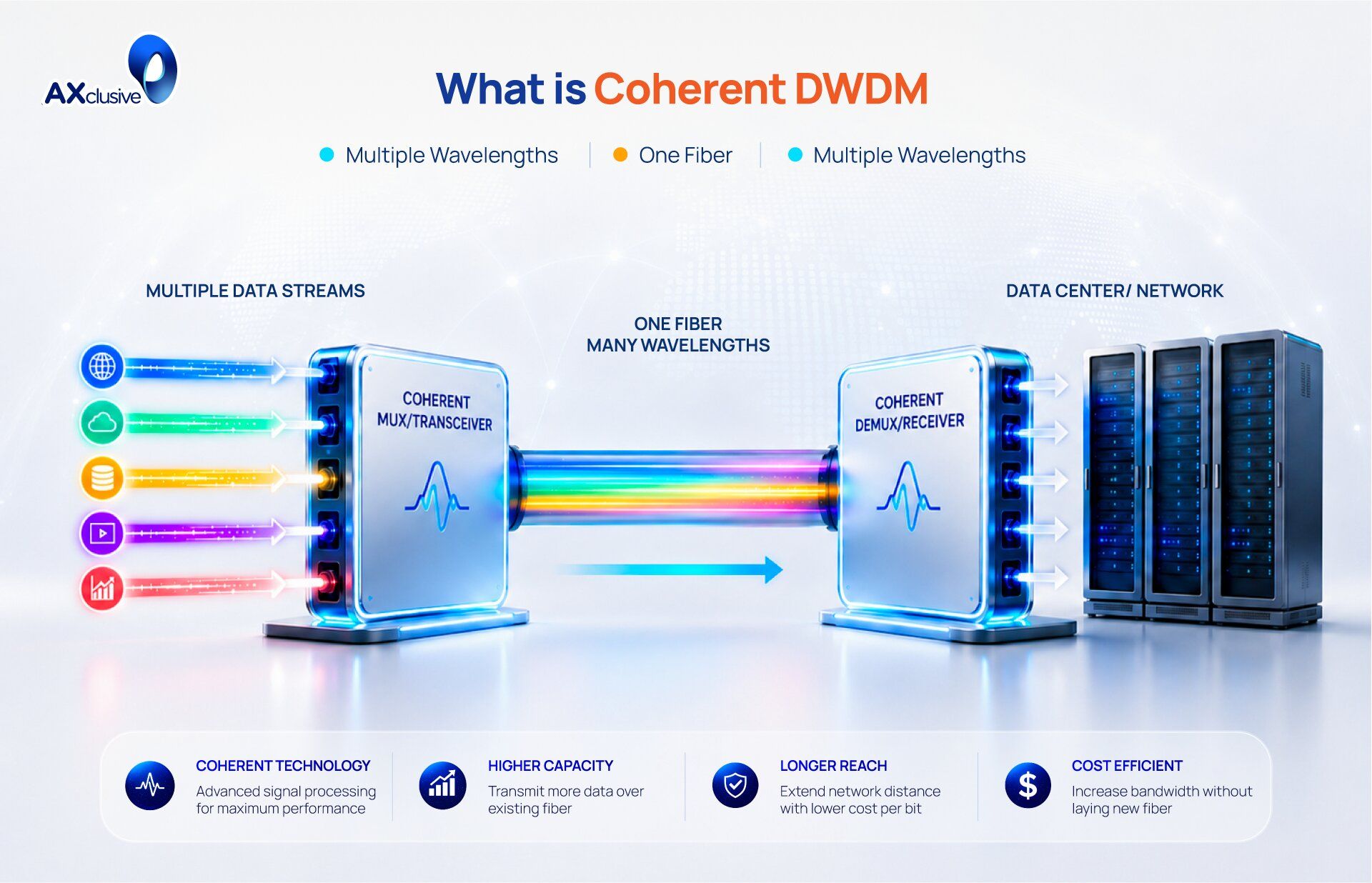
Coherent DWDM is an advanced optical transmission technology that uses the phase and polarization of light to maximize network capacity. Traditional systems rely on simple on-off pulses to send data. Coherent technology utilizes sophisticated modulation formats like Quadrature Amplitude Modulation (QAM) to transmit significantly more data per wavelength. By integrating Digital Signal Processors (DSP) and high-performance lasers, this method optimizes long-haul transmission and improves spectral efficiency. It allows telecommunication networks to achieve speeds of 100G, 400G, and 800G without requiring new physical fiber. This technology serves as the foundational standard for high-capacity internet backbones and global data center connectivity.
Coherent dwdm vs non coherent differences
| Feature | Non-Coherent Systems | Coherent Systems |
| Detection Method | Direct detection (checks light presence) | Coherent detection with local oscillator |
| Modulation | Amplitude (Intensity) Modulation | Phase, Frequency, and Polarization |
| Speed Capacity | Best for 2.5G to 10G | Ideal for 100G, 400G, and 800G+ |
| Spectral Efficiency | Low; limited bandwidth per channel | High; maximizes data per wavelength |
| Dispersion Handling | Needs physical compensation modules | Managed digitally by the DSP |
| Hardware | Simple and low-cost | Complex with high technical demands |
| Transmission Reach | Short to Medium (Metro) | Long-haul and Ultra Long-haul |
| ROADM Setup | Complex; needs many filters | Simple; receiver selects wavelengths |
Coherent dwdm core technologies
Coherent DWDM utilizes four primary technological pillars to achieve massive bandwidth. These systems move beyond simple light pulses to exploit the full physical properties of the electromagnetic spectrum. By combining advanced photonics with high-speed electronics, coherent networks transport data at 100G, 400G, and 800G speeds over existing fiber. Understanding these core technologies is essential for building long-haul optical infrastructure.
Modulation techniques
Traditional networks use Intensity Modulation to send data by turning light on and off. Coherent DWDM uses high-order modulation formats like Quadrature Amplitude Modulation (QAM) and Phase Shift Keying (PSK). These methods change the phase and amplitude of the light wave simultaneously. By encoding multiple bits into a single optical symbol, the system increases the total data rate without needing higher physical frequencies. This approach improves the optical signal-to-noise ratio (OSNR) and maximizes spectral efficiency.
Polarization transmission
Fiber optic glass supports two independent orthogonal polarizations. Coherent systems utilize Polarization Multiplexing (PM) to transmit two separate data streams on the same wavelength. This technique uses both the horizontal and vertical planes of the light wave to carry information. By using polarization transmission, the system effectively doubles the capacity of every wavelength. It also reduces the required speed of electronic components, which lowers hardware costs and improves system reliability for high-capacity links.
Signal detection
Coherent detection employs a local oscillator laser at the receiving end of the link. This laser mixes with the incoming light signal to extract data from its phase, amplitude, and polarization. This mixing process provides significantly higher sensitivity than standard direct detection. Because the detection process is linear, it captures the complete state of the light wave. This allows the system to accurately recover signals that have been weakened or distorted by long-distance travel through the fiber.
DSP processing
Digital Signal Processing (DSP) serves as the computational engine of a coherent system. The DSP chip performs complex mathematical calculations in real time at the electrical layer. Its primary role is to compensate for fiber impairments like Chromatic Dispersion (CD) and Polarization Mode Dispersion (PMD). In older systems, these issues required expensive physical compensation modules. Modern DSP processing fixes these distortions digitally. This eliminates the need for extra hardware sites and allows for more flexible, software-defined network management.
Coherent dwdm key benefits
Coherent DWDM technology redefines optical networking by delivering higher bit rates, superior performance, and a streamlined physical infrastructure. By leveraging advanced signal processing to overcome traditional fiber limitations, it allows data to travel further and faster without expensive physical workarounds. Organizations upgrading their backbone gain four distinct operational advantages that directly improve network reliability and reduce capital expenditures.
Simpler network setup
Building long-haul optical networks traditionally required complex planning and massive hardware deployment. Coherent DWDM simplifies this process through soft-decision Forward Error Correction (FEC). FEC encodes the original data signal with additional overhead information. The receiving equipment uses this data to detect and correct transmission errors automatically.
This digital correction provides a much larger optical margin. Consequently, high-speed signals travel significantly farther before needing a physical regenerator to boost the light. By reducing the number of regenerator sites, network operators deploy less equipment. This cuts hardware costs, reduces maintenance points, and accelerates the deployment timeline for new fiber routes.
Higher fiber capacity
Maximizing the data output of existing fiber strands is a primary goal for network providers. Coherent DWDM achieves this through a technique called spectral shaping. This process applies dynamic processing across the frequency spectrum to optimize how light behaves inside the glass core.
Spectral shaping works seamlessly with cascaded Reconfigurable Optical Add-Drop Multiplexers (ROADMs). In flexible grid systems, this technique allows engineers to squeeze optical carriers much closer together. By minimizing the unused space between channels, you dramatically increase spectral efficiency. This translates to more data lanes on the exact same physical fiber, maximizing your infrastructure investment.
Flexible deployment
Modern network demands fluctuate constantly. Coherent DWDM provides the agility required to meet these changing needs without replacing physical hardware. Coherent optical line cards are fully programmable. They support multiple modulation formats and variable baud rates.
Network operators can choose the exact line rate that fits a specific distance or fiber quality. A short link can run at maximum capacity, while a long-haul link can prioritize signal stability. Fully tunable transceivers allow for fine granularity adjustments. This flexibility ensures you utilize every gigabit of available capacity, converting excess optical margin into active, revenue-generating services.
Better dispersion handling
Light signals degrade as they travel through physical fiber cables. Two major impairments are Chromatic Dispersion (CD) and Polarization Mode Dispersion (PMD). In legacy networks, engineers mapped these distortions physically and installed expensive Dispersion Compensation Modules (DCMs) to fix them.
Coherent DWDM eliminates this physical headache. Powerful Digital Signal Processors (DSPs) mitigate these dispersion effects electronically. This removes the cost and latency associated with physical DCM coils. The DSP also tracks the State of Polarization (SOP) and improves tolerance to Polarization-Dependent Loss (PDL) to prevent bit errors. As a result, you can deploy 400G line rates over extreme distances. The technology even allows aging, low-quality fiber to support high-speed traffic that previously failed at lower speeds.
Implementing Coherent DWDM provides a strategic advantage for future-proofing your optical infrastructure. By maximizing existing fiber capacity and eliminating complex physical hardware, this technology delivers exceptional speed, flexibility, and cost-efficiency. Axclusive hopes this guide equips you with the technical insights needed to confidently upgrade your network architecture and meet escalating data demands.
What is Coherent DWDM and how it enables high-capacity, long-distance optical transmission. Contact us to build scalable fiber connectivity with Axclusive ISP.