
What Is a DDoS Attack? How It Works and Types
DDoS attack pose an existential threat to your digital availability. To defend your infrastructure, you must understand what is DDoS protection—the essential shield that filters malicious traffic at the edge. Join Axclusive in the article below as we explore the best practices and platform strategies to secure your network against modern cyber threats.
What is a DDoS attack?
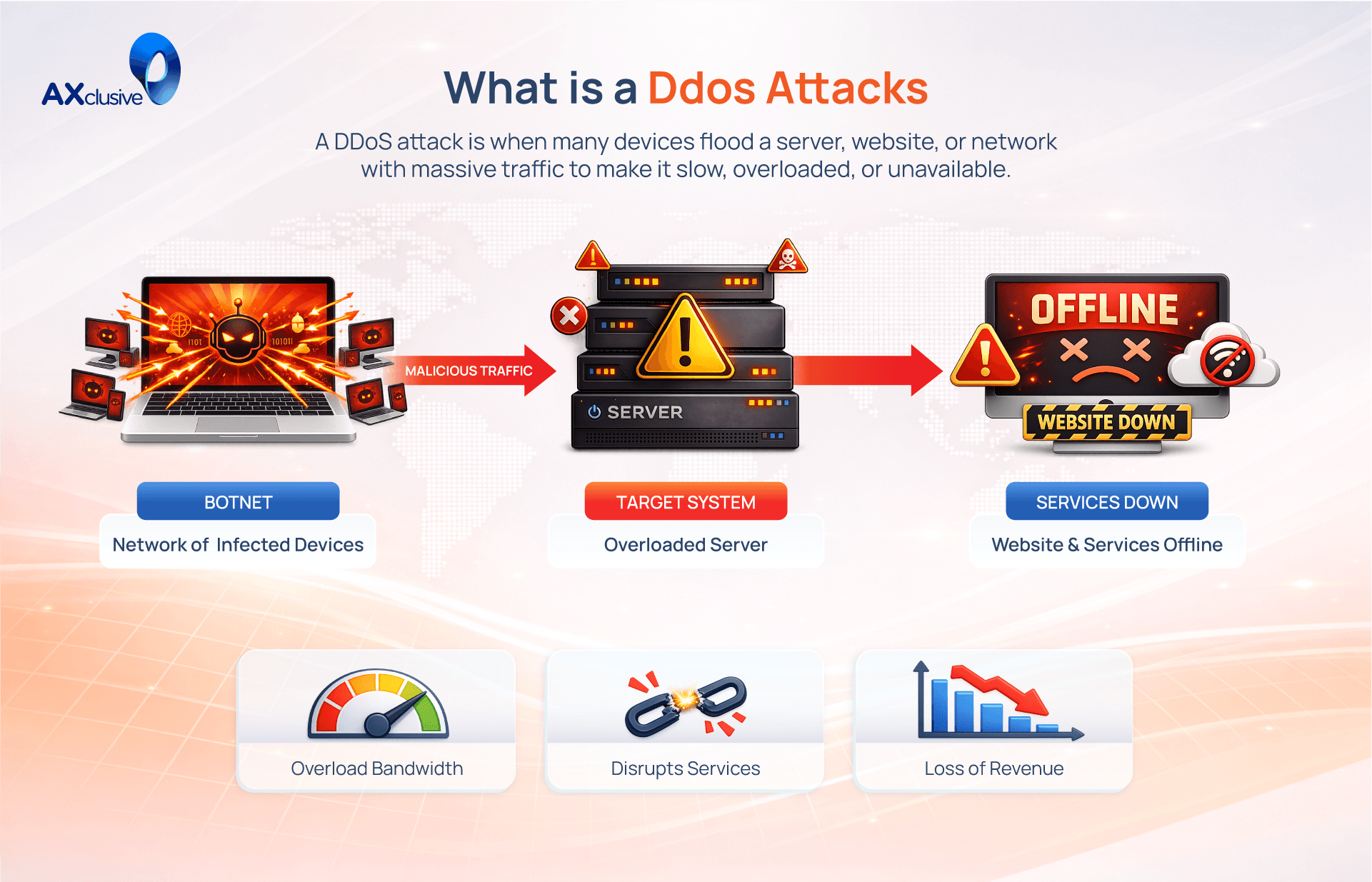
DDoS attack is a malicious cyber threat designed to knock websites, servers, or entire networks offline by burying them under a massive wave of artificial internet traffic. Cybercriminals execute this by hijacking thousands of compromised systems, including infected computers and everyday smart devices, to launch a coordinated assault. This overwhelming surge rapidly consumes all available bandwidth and processing power, creating a severe digital gridlock that completely locks out legitimate users from accessing the service.
The Growing Threat of DDoS Attack
DDoS attack continue to be a significant cybersecurity threat as attackers gain access to more connected devices, automated tools, and distributed infrastructure. Several factors contribute to the continued prevalence of these attacks:
- Easy Access to Attack Resources: Launching a DDoS attack does not always require advanced technical expertise. Attackers can gain access to compromised devices and ready-made attack infrastructure, making it easier to generate large amounts of malicious traffic with limited preparation.
- Difficult Traffic Identification: Malicious DDoS traffic can sometimes resemble legitimate website or application activity. When requests originate from many different devices and locations, distinguishing an attack from a genuine increase in user traffic can become more challenging.
- Distributed Attack Sources: DDoS attacks can generate traffic from large numbers of compromised devices and IP addresses simultaneously. As a result, simply blocking individual sources may not stop an attack, while overly aggressive filtering can also disrupt legitimate users.
- Growth of IoT Devices: The increasing number of Internet-connected devices creates more potential targets for compromise. IoT devices with weak passwords, outdated software, or poor security configurations may be exploited and incorporated into botnets used to generate attack traffic.
- Evolving Attack Techniques: Attackers continue to develop new methods and combine different types of DDoS traffic to bypass security controls. Automated techniques can also change attack patterns during an incident, making continuous traffic monitoring and adaptable DDoS mitigation important for maintaining network availability.
Keep your business online and your critical services available during unexpected traffic attacks. Explore DDoS Protection with Axclusive ISP.
How a DDoS Attack Works
A DDoS attack works by generating traffic or requests from many distributed devices and directing them toward the same target at the same time. Attackers commonly achieve this by controlling a collection of compromised computers, servers, or Internet of Things (IoT) devices, known collectively as a botnet.
Once activated, the compromised devices simultaneously send traffic to the targeted website, application, server, or network. When the volume of malicious traffic exceeds the target's available bandwidth, connection capacity, or computing resources, performance can slow significantly or services may become unavailable. As a result, legitimate users may have difficulty accessing the affected service even though their requests are valid.
Common Types of DDoS Attack
Threat actors deploy distinct strategies depending on which layer of the target infrastructure they want to disrupt. Based on the specific system resources they aim to exhaust, these malicious intrusions generally fall into three primary classifications:
- Volumetric Floods: This method focuses entirely on saturating all available bandwidth connecting the victim to the broader internet. By blasting an infrastructure with an astronomical surge of artificial data, the network pipeline becomes completely congested. Real visitors find the service sluggish or entirely unreachable. A widespread example is DNS amplification, where cybercriminals manipulate open domain name servers to generate massive waves of magnified traffic toward the victim.
- Protocol Disruptions: Rather than simply choking raw bandwidth, these threats target the operational mechanics of network and transport protocols. They aim to drain the internal processing capabilities of core hardware like firewalls, routers, and load balancers. A typical instance is an SYN flood, which bombards a system with millions of initial connection requests but intentionally never completes the handshake, leaving the server with zero capacity to handle authentic connections.
- Application Layer Invasions: Operating at Layer 7 of the OSI model, these sophisticated assaults directly target web software, APIs, and online databases. What makes them exceptionally dangerous is that the incoming queries closely resemble regular human browsing behavior. A prime example is an HTTP flood, which repeatedly requests resource intensive web pages, rapidly overwhelming backend processors and crashing the platform for genuine users.
Common Signs of a DDoS Attack
Common signs that may indicate a DDoS attack include the following. While DoS vs DDoS Attacks differ in how attack traffic is generated and distributed, both can cause similar symptoms such as network congestion, service disruption, and downtime:
- Sudden Traffic Spikes: Unexpected increases in network or website traffic.
- Slow or Unavailable Services: Websites or applications become unusually slow or inaccessible.
- Unusual Traffic Sources: Large numbers of requests originate from similar IP ranges, locations, or devices.
- Excessive Requests: A specific page, API, or service receives unusually high request volumes.
- Frequent Errors and Timeouts: Users experience connection failures, server errors, or delayed responses.
- Multiple Services Affected: Several services on the same network slow down at the same time.
Ultimately, learning what is a ddos attack reveals just how fragile an unprotected network can be in today digital landscape. Cybercriminals will not wait to test your defenses, and a single wave of malicious traffic can take your business completely offline within seconds. Do not wait for an attack to disrupt your operations before investing in proper security. Deploy scalable cloud based mitigation tools today. Axclusive ISP is always ready to help you fortify your servers and ensure continuous network uptime.
Discover what is a DDoS attack and learn how to safeguard your network from disruptive threats. Contact us today to build a stronger, smarter defense against modern cyber attacks