
What Is User Datagram Protocol? How UDP Works
Navigating the complexities of high-speed networking often leads to the User Datagram Protocol. Designed for maximum efficiency and rapid data transmission, this protocol serves as a critical backbone for today’s real-time digital experiences. Join Axclusive to explore its mechanics, core applications, and unique advantages in the article below.
What is User Datagram Protocol ?
User Datagram Protocol (UDP) is a connectionless internet protocol optimized for maximum speed and minimal latency. By eliminating the need for a pre-established handshake before transmitting data, UDP is highly efficient for time-sensitive tasks like real-time media playback and DNS routing. While it excels at fast data transfer, UDP sacrifices built-in error checking, resulting in potential packet loss and an increased susceptibility to DDoS exploits.
How the User Datagram Protocol Transmits Data
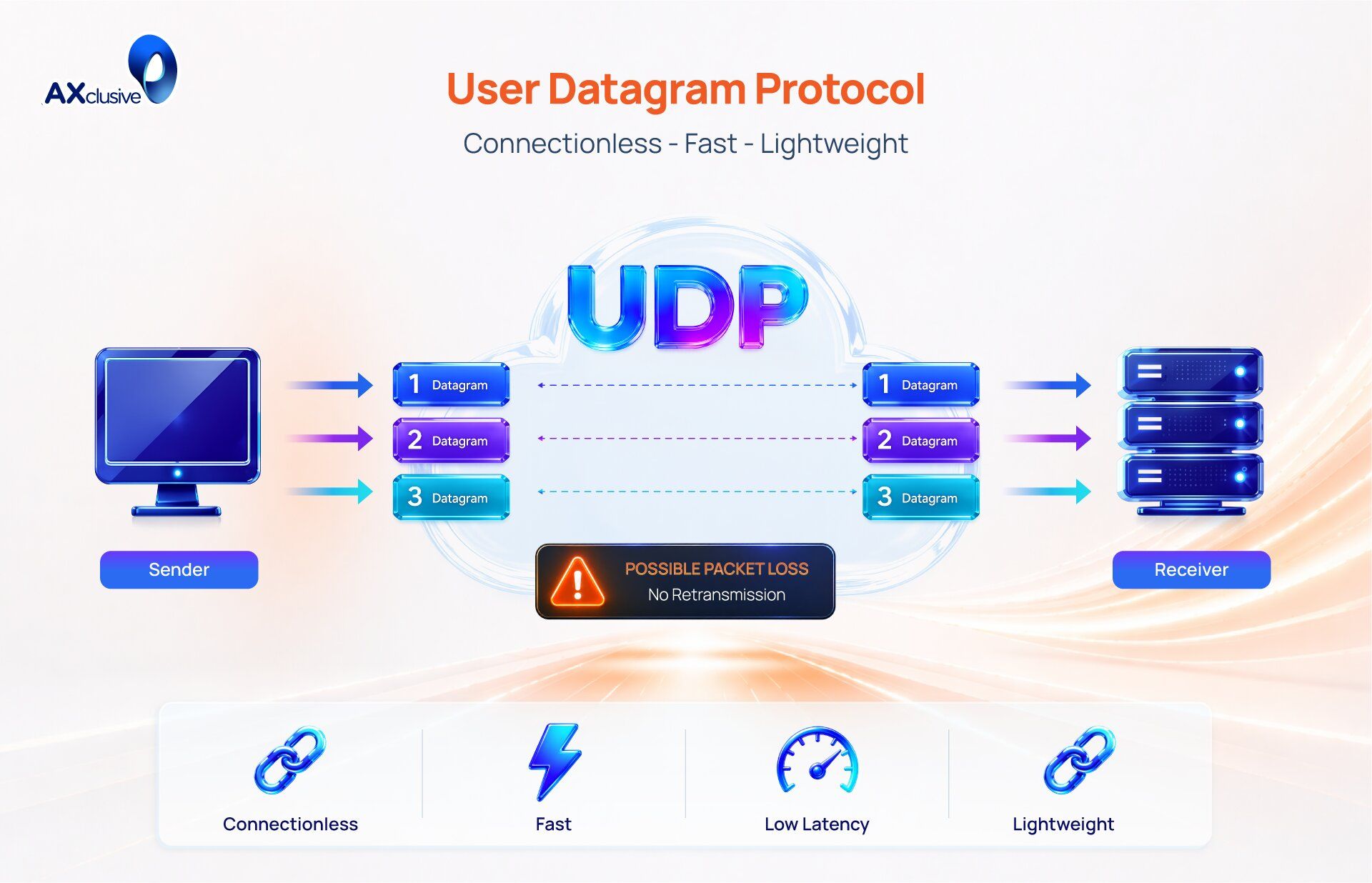
At its core, UDP is a streamlined networking standard designed to move information between computers as quickly as possible. It achieves this by taking a direct, connectionless approach to data transmission.
Instead of setting up a complex communication channel, UDP packages information into specific units called datagrams and fires them directly at the target device. This transmission process is defined by three strict rules:
- No Setup Required: UDP begins sending datagrams immediately, without establishing a prior connection (often called a "handshake") with the receiving computer.
- No Sequential Ordering: Packets are dispatched independently. The protocol does not number them, meaning they may arrive at the destination out of order.
- No Delivery Confirmation: UDP does not monitor whether the datagrams actually reach their target. If a packet drops during transit, there is no system in place to resend it.
User Datagram Protocol in DDoS Attack Scenarios
While UDP’s speed is highly beneficial for streaming and gaming, its lack of strict connection rules makes it a frequent weapon for cybercriminals. Because UDP is a "connectionless" protocol, it does not require a standard network handshake. This allows attackers to flood a target server with massive amounts of traffic without ever waiting for connection approval.
How a UDP Flood Attack Works
The most common exploit is the UDP flood. In this scenario, the attack unfolds in three rapid steps:
- The Bombardment: Attackers send a massive volume of fraudulent UDP datagrams to random ports on the target server.
- The Forced Response: The server must process each request. Finding no active applications on these random ports, it is forced to reply to every single fake datagram with an ICMP "Destination Unreachable" packet.
- Resource Exhaustion: The continuous cycle of receiving junk data and generating ICMP responses rapidly depletes the server’s computing power, ultimately taking it offline and denying service to legitimate users.
How to Defend Against UDP Floods
To ensure high availability and protect origin servers, network administrators typically rely on two primary mitigation strategies:
- ICMP Rate Limiting: Firewalls and routers can be configured to limit the volume of ICMP responses the server is allowed to send. While effective, this must be tuned carefully to avoid blocking legitimate network diagnostic traffic.
- Distributed Mitigation Networks: The most robust defense is routing incoming UDP traffic through an Anycast network or distributed data centers (like a CDN). These intermediary networks act as a shield, absorbing and filtering fraudulent packets at the network edge before they can overwhelm the main server.
Common Use Cases of the User Datagram Protocol
Because UDP prioritizes raw speed and minimal overhead over guaranteed delivery, it is the ideal transport layer protocol for applications where slight data loss is acceptable, but lag is not.
Network engineers and developers primarily utilize UDP across four core areas:
- Real-Time Applications: UDP delivers information quickly and seamlessly. It is the backbone of live video streaming, online gaming, and Voice over IP (VoIP), frequently powering the Real Time Streaming Protocol (RTSP).
- Rapid Request/Response Systems: When transmitting very small amounts of data, the overhead of establishing a formal connection is unnecessary. UDP is highly efficient for these quick, straightforward queries. Most notably, it powers the Domain Name System (DNS), Network Time Protocol (NTP), and the Quote of the Day Protocol (QOTD).
- Network Administration & Infrastructure: Many fundamental network operations rely on UDP due to its lightweight nature and lack of complex flow control. Essential implementations include:
- IP Assignment: DHCP (Dynamic Host Configuration Protocol) and BOOTP.
- Routing Updates: RIP (Routing Information Protocol).
- Basic Data Transfer: TFTP (Trivial File Transfer Protocol) and NNP (Network News Protocol).
- Multicasting: Because UDP does not require a one-to-one handshake, it is highly compatible with packet switching. This makes it the standard protocol for multicasting, allowing a single source to broadcast data to multiple recipients simultaneously without overwhelming the network.
Advantages and Disadvantages of the User Datagram Protocol
Choosing the right transport layer protocol depends entirely on your application's specific requirements. To determine if UDP is the correct choice for your network architecture, consider its primary strengths and limitations.
Advantages of UDP
- Blazing Fast: Because UDP is connectionless, it skips the time-consuming handshake process required by TCP, allowing for immediate data transmission.
- Low Overhead: It is a highly efficient, lightweight protocol. Smaller packet headers mean less bandwidth is consumed per transmission.
- Optimized for Real-Time: UDP is the industry standard for latency-sensitive applications. For live streaming, VoIP, and online gaming, delivering data quickly is far more important than perfect accuracy.
Disadvantages of UDP
- No Delivery Guarantees: UDP operates on a "best-effort" basis. It does not track packet delivery, meaning data can be dropped, duplicated, or arrive completely out of sequence with no built-in recovery mechanism.
- Zero Congestion Control: Unlike TCP, UDP will continue pushing data regardless of network conditions. If not carefully managed at the application layer, it can flood and overwhelm a network.
- Unsuited for Exact Data Transfers: Because it lacks reliability, UDP is the wrong choice for applications that require strict data integrity, such as sending emails, loading standard web pages, or transferring secure files.
The User Datagram Protocol offers a powerful trade-off between raw speed and reliability, making it indispensable for today's low-latency digital demands. Mastering its unique mechanics and security challenges allows for a more robust and responsive network environment. Continue exploring technical excellence and advanced networking insights with Axclusive.
User Datagram Protocol supports fast, low-latency data transmission for real-time applications. Contact us to optimize your network connectivity with Axclusive ISP.