
AI Training vs. AI Inferencing: What They Are, How They Differ, and Why Your Network Is the Hidden Bottleneck
Quick answer: AI training is the resource-intensive process of teaching a model by feeding it massive datasets over days or weeks, typically on clustered GPUs that need extremely high-bandwidth, low-latency interconnects. AI inferencing is what happens after training — using the finished model to generate real-time predictions or responses for end users, where the priority shifts from raw throughput to consistent low latency and geographic proximity to users. Both stages depend on network infrastructure that most teams underestimate until it becomes their bottleneck.
Introduction
Every AI product a business ships — a chatbot, a recommendation engine, a fraud-detection system — runs on two fundamentally different computational processes: training and inferencing. Understanding the distinction isn't academic. It shapes hardware procurement, cloud spend, data center location, and — critically — the network architecture connecting all of it together.
This article breaks down what AI training and inferencing actually involve, why their infrastructure needs diverge so sharply, and where a carrier-neutral network operator fits into the picture for companies building or scaling AI workloads in Southeast Asia and beyond.
Scale bandwidth and strengthen network resilience with a flexible data center connectivity solution designed for demanding workloads.
What Is AI Training?
AI training is the process of exposing a machine learning model to large volumes of data so it can learn statistical patterns, weights, and relationships. In practical terms, training means:
- Feeding a neural network millions to trillions of data points (text, images, sensor data, etc.)
- Running repeated forward and backward passes (epochs) to adjust internal parameters
- Using distributed clusters of GPUs or TPUs that must synchronize constantly with each other
Key characteristics of AI training workloads:
| Attribute | Typical Profile |
| Duration | Hours to weeks (sometimes months for large foundation models) |
| Compute pattern | Sustained, parallel, extremely high GPU utilization |
| Network need | Ultra-high bandwidth, ultra-low latency between GPU nodes (east-west traffic) |
| Data movement | Massive datasets ingested once, then continuous inter-node gradient synchronization |
| Failure tolerance | Low — a network hiccup can stall or corrupt an entire training run |
Training is where terms like "GPU cluster interconnect," "RDMA," "InfiniBand vs. RoCE," and "east-west bandwidth" matter most. The network isn't a supporting actor here — it is often the single largest determinant of how fast (and how expensively) a model gets trained.
What Is AI Inferencing?
AI inferencing is what happens after a model is trained: it's the act of running new, unseen input through the trained model to produce an output — a chatbot reply, a translated sentence, a fraud score, a product recommendation.
Key characteristics of AI inferencing workloads:
| Attribute | Typical Profile |
| Duration | Milliseconds to seconds, per request |
| Compute pattern | Bursty, unpredictable, driven by live user demand |
| Network need | Low, consistent latency to the end user (north-south traffic) |
| Data movement | Small payloads in, small payloads out — but constant and high-frequency |
| Failure tolerance | User-facing — latency spikes or downtime are immediately visible to customers |
Where training is a backend, batch-oriented process, inferencing is a live, customer-facing one. This is why inferencing workloads increasingly move toward edge locations — data centers physically closer to end users — rather than staying centralized in a single mega-cluster.
AI Training vs. AI Inferencing: The Core Differences
- Where the bottleneck lives. Training bottlenecks appear inside the data center, between GPUs. Inferencing bottlenecks appear outside the data center, on the path to the user.
- What "fast" means. Training cares about aggregate throughput across a cluster. Inferencing cares about round-trip latency for a single request.
- Where it should physically run. Training benefits from centralization — one location with maximum interconnect density. Inferencing benefits from distribution — many smaller points of presence near demand centers.
- Cost structure. Training is capital- and power-intensive in short, intense bursts. Inferencing is an ongoing operational cost that scales with usage and user growth.
- Network traffic direction. Training traffic is overwhelmingly east-west (server to server). Inferencing traffic is overwhelmingly north-south (server to end user).
Why the Network Layer Is the Part Everyone Underestimates
Compute (GPUs) and storage get most of the attention in AI infrastructure conversations. But both training and inferencing live or die on the network connecting them:
- A training cluster with world-class GPUs but a congested, high-latency interconnect will leave those GPUs idle waiting on data — wasting enormous capital.
- An inferencing deployment with a great model but poor network peering to end users in Southeast Asia will feel slow and unreliable no matter how good the model is, especially for real-time use cases like voice AI, live translation, or agentic tool-calling.
This is where network architecture decisions — which upstreams you peer with, how many hops your traffic takes, whether your PoPs sit close to major internet exchanges — stop being a background IT concern and become a product-quality issue.
Frequently Asked Questions
Is AI inferencing more expensive than AI training?
Individually, a single training run usually costs more than a single inference request. But because inferencing runs continuously at scale — every user query, every API call — cumulative inferencing costs often exceed total training costs over a model's deployed lifetime.
Does AI inferencing need GPUs?
Often yes, though inferencing can also run efficiently on CPUs or specialized inference chips for smaller models. Large models still typically require GPU or accelerator hardware, but with far less inter-node communication than training requires.
Why does latency matter more for inferencing than training?
Training is a batch process with no live user waiting on each step, so it tolerates latency as long as total throughput is high. Inferencing responses are consumed by real users or downstream systems in real time, so even small latency increases are directly felt as a worse experience.
Can the same data center handle both AI training and inferencing?
Yes, but they're often optimized differently. Many organizations centralize training in a small number of high-density GPU facilities while distributing inferencing across multiple regional points of presence closer to users.
What network features matter most for AI workloads?
For training: high east-west bandwidth, low inter-node latency, and reliable, non-blocking interconnects. For inferencing: low, stable latency to end users, strong peering with regional networks and internet exchanges, and redundant upstream connectivity to avoid single points of failure.
How Axclusive Supports Companies on Their AI Infrastructure Journey
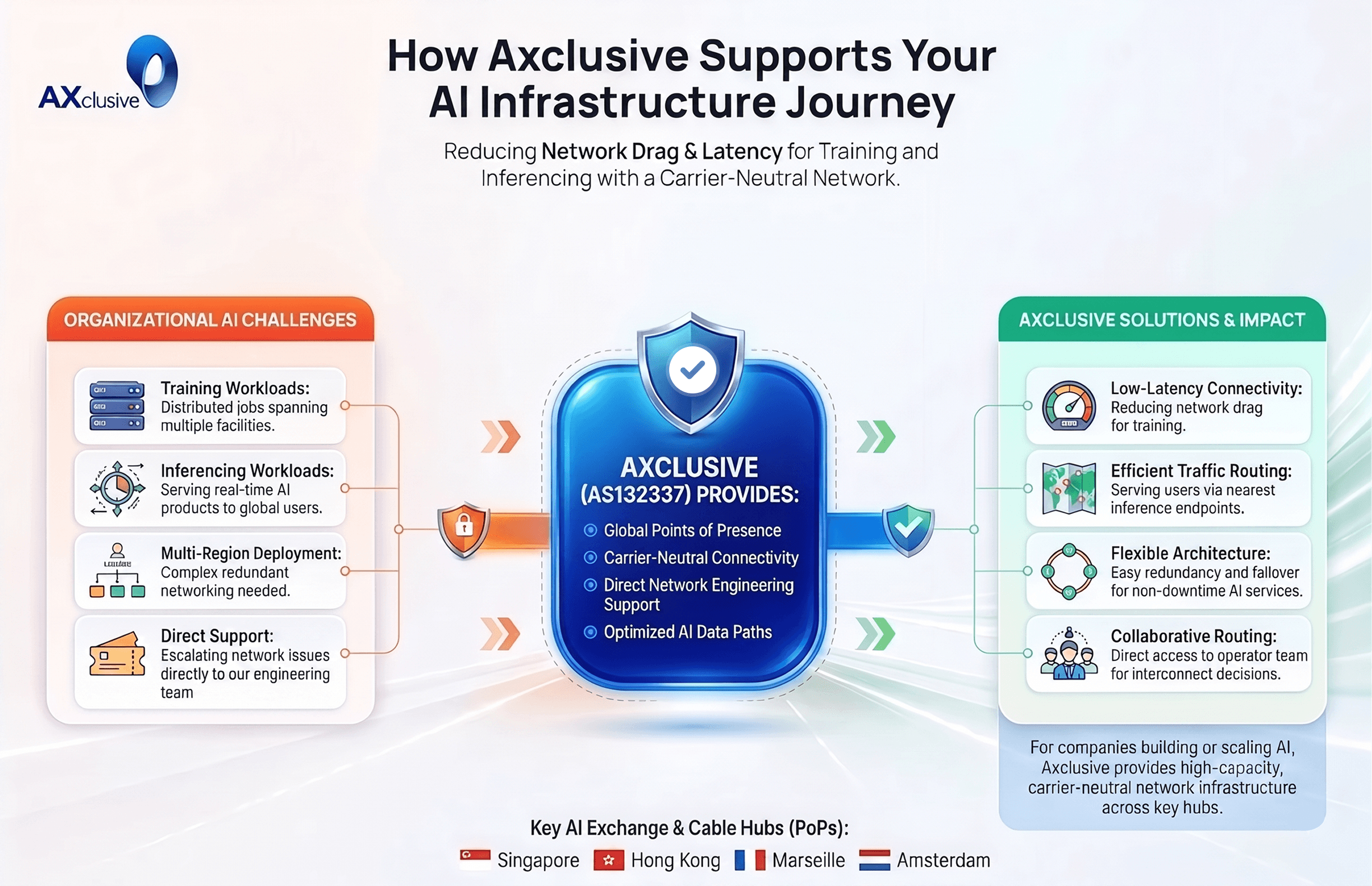
Axclusive (AS132337) is an independent, carrier-neutral network operator and ISP with points of presence in Singapore, Hong Kong, Marseille, and Amsterdam — spanning some of the world's most important internet exchange and subsea cable hubs. For companies building or scaling AI workloads, that footprint maps directly onto the two problems above:
- For training workloads: Axclusive can provide high-capacity, low-latency connectivity between data centers and cloud regions, reducing the network drag on distributed training jobs that span multiple facilities or providers.
- For inferencing workloads: With PoPs across Asia-Pacific and Europe, Axclusive can help route user traffic to the nearest available inference endpoint efficiently, reducing round-trip latency for real-time AI products serving Southeast Asian and European users.
- Carrier neutrality: Because Axclusive isn't tied to a single upstream, companies get flexibility in how they architect redundancy and failover for AI services that can't afford downtime.
- Direct network engineering support: As an operator (not a reseller), Axclusive's team can work directly on routing, peering, and interconnect decisions rather than escalating through layers of support tickets.
If your organization is planning GPU cluster interconnects, multi-region inferencing deployment, or simply trying to understand where network performance is silently taxing your AI roadmap, that's a conversation worth having early — network architecture is far cheaper to get right at the design stage than to retrofit after launch.
AI Training Needs More Than Powerful GPUs
See how AI Infrastructure for Model Training brings together high-speed connectivity, data movement, and storage to support demanding AI workloads.
Key Takeaways
- AI training = teaching the model. Needs massive east-west bandwidth and low inter-node latency within a cluster.
- AI inferencing = using the model. Needs low, stable north-south latency to end users, often via distributed edge locations.
- The network is not a secondary consideration for either — it is frequently the limiting factor on both cost and performance.
- Choosing the right network partner and topology early avoids expensive retrofits later.
Interested in discussing network architecture for your AI training or inferencing workloads? Contact Axclusive to talk through your requirements.