
AI Infrastructure for Model Training: How Axclusive Moves, Stores, and Connects Your AI Data
Quick answer: AI training bottlenecks are rarely caused by GPU shortage — they're caused by data movement. Axclusive (AS132337) provides the network backbone, direct cloud interconnects, and petabyte-scale storage that keeps GPU clusters fed and training costs under control, across PoPs in Singapore, Hong Kong, Amsterdam, and Marseille.
Most conversations about AI infrastructure start and end with GPUs. But GPUs are only useful if data reaches them fast enough. Modern AI teams routinely move and store hundreds of terabytes to multiple petabytes of data across the model lifecycle — and cloud GPU providers, on their own, don't solve global data acquisition, high-speed transfer, long-term retention, or hybrid-cloud connectivity.
Axclusive delivers the networking and storage foundation underneath all of it.
The AI Data Lifecycle, Stage by Stage
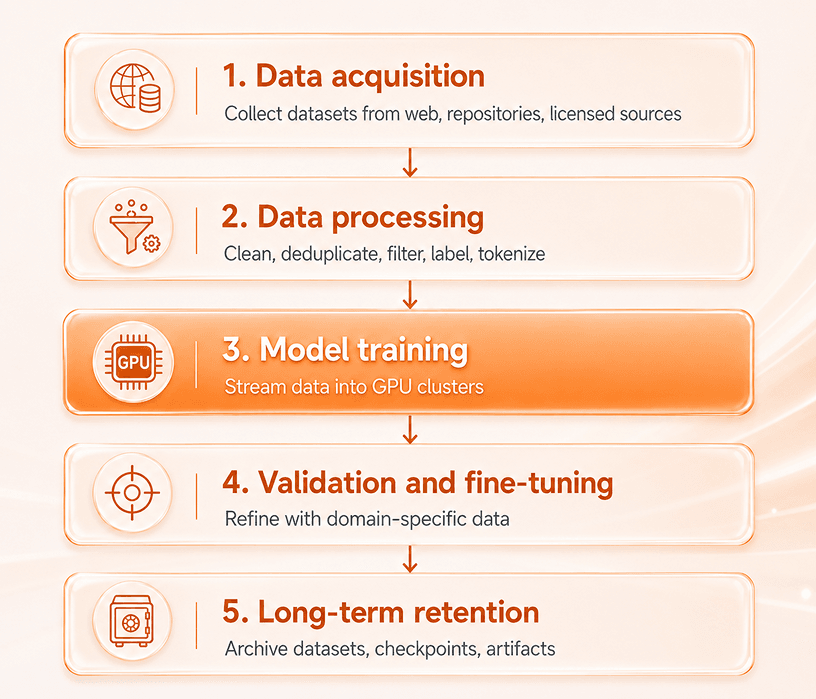
Every AI training workflow moves through the same five stages, each with different infrastructure demands:
Data Acquisition — collecting datasets from the web, public repositories, enterprise systems, or licensed providers.
Data Processing — cleaning, deduplication, filtering, labeling, and tokenization.
Model Training — streaming processed data into GPU clusters on cloud or private infrastructure.
Validation & Fine-Tuning — refining models against domain-specific datasets.
Long-Term Retention — preserving datasets, checkpoints, and model artifacts for retraining, compliance, and reproducibility.
All five stages depend on the same underlying resource: reliable, high-throughput connectivity.
Challenge 1: Acquiring Data at Global Scale
Foundation models, computer vision systems, and recommendation engines need datasets pulled from multiple regions simultaneously. The hard part isn't downloading data once — it's downloading it consistently and at scale, without regional bottlenecks.
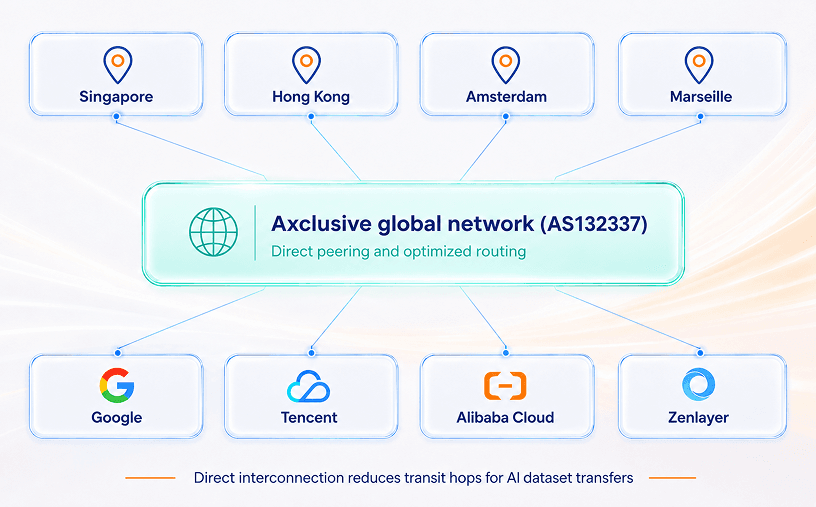
Axclusive operates direct interconnections with major cloud and content ecosystems — including Google, Tencent, Alibaba Cloud, and Zenlayer — layered on an extensive global peering base. That reduces unnecessary transit hops between your infrastructure and the platforms where your data and compute already live, which translates into:
Faster large-scale dataset acquisition
More consistent cross-region synchronization
Fewer failed or stalled transfers during bulk ingestion
Challenge 2: Keeping Expensive GPUs Fed
GPU clusters are billed whether they're computing or waiting. If storage or network throughput can't keep pace, utilization drops and training costs rise for no additional output.
Axclusive's PoPs in Singapore, Hong Kong, Amsterdam, and Marseille provide high-capacity connectivity to major cloud GPU regions, so datasets reach training clusters on Google Cloud, Alibaba Cloud, or other providers with fewer stalls and more predictable transfer windows.
Challenge 3: Cutting Long-Term Storage Costs Without Losing the Data
Once training ends, most organizations no longer need constant access to the full dataset — but they can rarely delete it, because it's needed for future retraining, audits, compliance, and reproducibility.
Leaving petabytes of cold data in cloud object storage is one of the most common unnecessary AI costs. The alternative: back the data haul out of the cloud into dedicated storage, keeping it accessible without paying cloud-tier prices indefinitely. This typically covers:
Raw and processed datasets
Tokenized training data
Model checkpoints
Fine-tuning datasets and experiment metadata
Axclusive provides secure, high-speed data backhaul from cloud environments into private, petabyte-scale storage.
Challenge 4: Connecting a Hybrid AI Stack
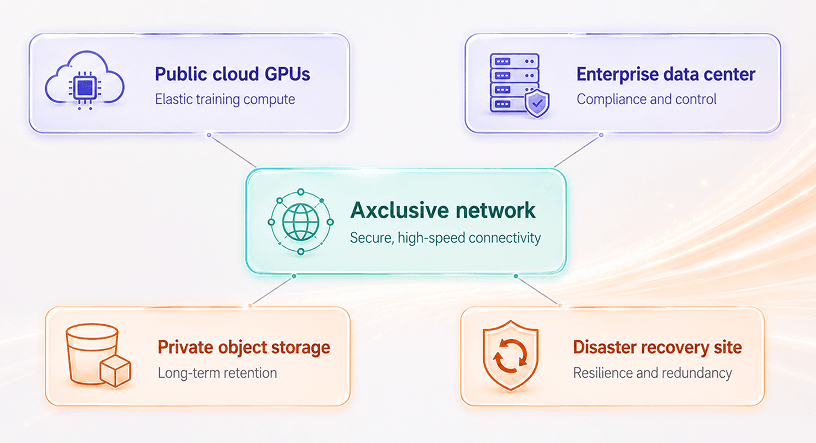
Few AI deployments live in one place. A typical stack spans public cloud GPUs, private object storage, enterprise data centers, colocation facilities, and disaster-recovery sites — and moving data between them, not any single component, is usually the weakest link.
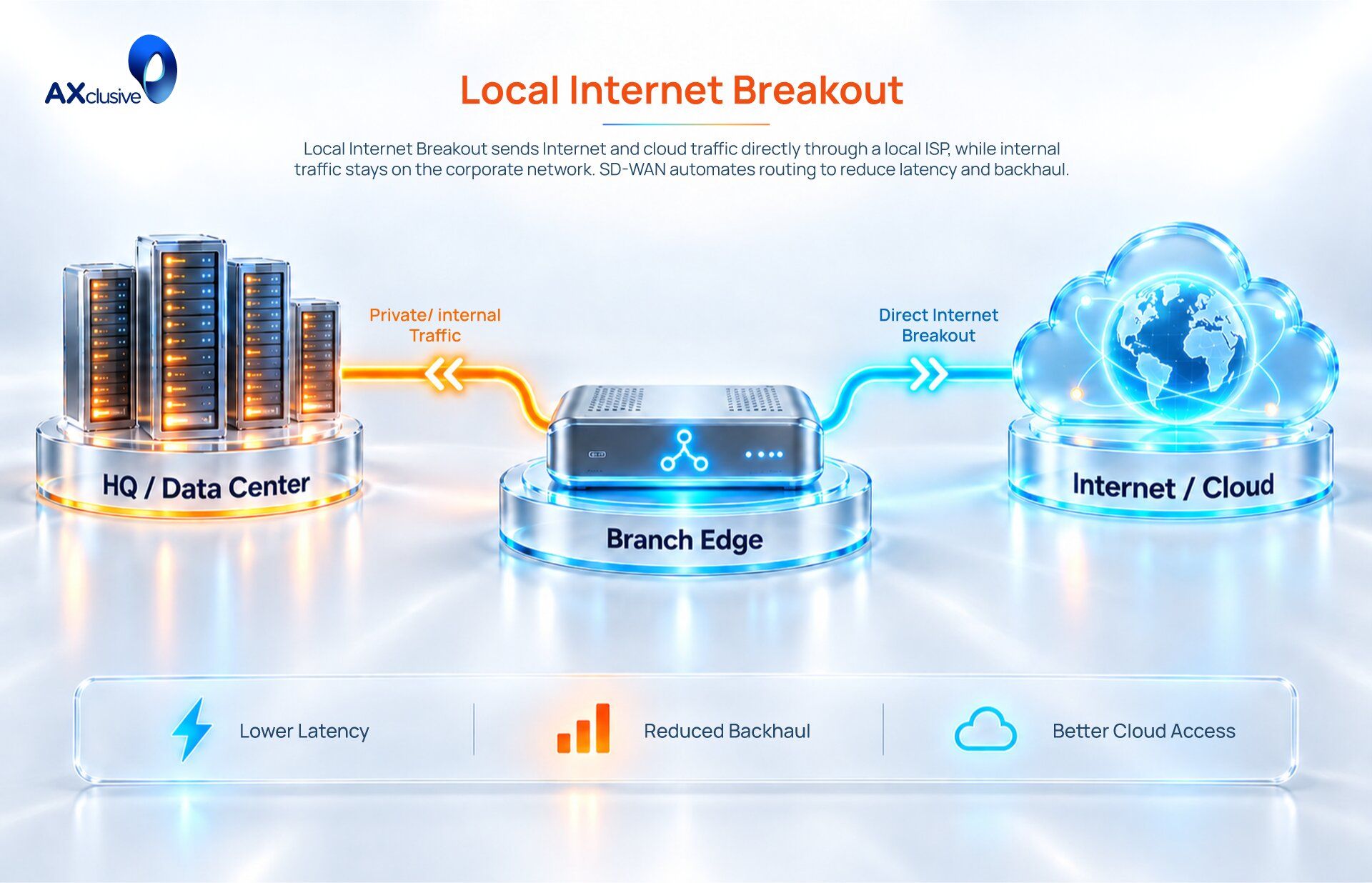
Axclusive connects these environments directly through dedicated links, enterprise Internet, and high-capacity international connectivity — so large transfers don't have to depend solely on the public Internet, and data location stays under your control.
What Axclusive Provides
| Service | What it solves |
| Enterprise Internet Connectivity | High-throughput bandwidth for large-scale AI data movement |
| Dedicated Cloud & Data Center Connectivity | Predictable, secure links between infrastructure, cloud, and colocation |
| Petabyte-Scale Storage | Long-term retention for datasets, checkpoints, and artifacts |
| Cloud Data Backhaul | Moves trained datasets and artifacts out of cloud storage for cheaper long-term retention |
| Global Connectivity | PoPs in Singapore, Hong Kong, Amsterdam, and Marseille for distributed AI teams |
Who This Is For
AI startups, LLM developers, ML platform providers, enterprise AI teams, research institutions, healthcare AI, financial AI, autonomous vehicle developers, computer vision companies, and SaaS providers building AI-powered products.
FAQ
What network speed do I need for AI training?
10 Gbps to 100 Gbps or higher, depending on dataset size and how often you retrain.
Should AI companies archive their training datasets?
Yes, in most cases — datasets are needed later for retraining, compliance, audits, and reproducibility, so they're rarely safe to delete.
Is cloud storage the best option for long-term AI data?
Not always. Cloud storage is best for active, frequently-accessed data. For cold or infrequently accessed datasets, private or hybrid storage usually costs less over time.
Can AI companies train in the cloud but store data privately?
Yes, training on cloud GPUs while archiving datasets to private infrastructure, connected via high-speed enterprise networking, is a common hybrid pattern.
Does Axclusive provide direct cloud connectivity?
Yes ,Axclusive maintains direct interconnections with Google, Tencent, Alibaba Cloud, and Zenlayer, plus PoPs in Singapore, Hong Kong, Amsterdam, and Marseille.
AI infrastructure is a data-movement problem before it's a compute problem. Axclusive provides the network, interconnection, and storage layer that keeps data flowing between acquisition, training, and long-term retention — so GPU spend goes toward training, not waiting.