
What Is a Session Border Controller? Architecture Types and Voice Security
As modern enterprises transition to cloud voice and IP telephony, understanding what is a session border controller has become essential for securing corporate communications. Acting as a specialized gatekeeper stationed at the network perimeter, this critical appliance regulates, protects, and optimizes interactive real time multimedia traffic, including VoIP and video conferencing. Join Axclusive ISP in this guide as we explore exactly how this technology operates.
What is a Session Border Controller?
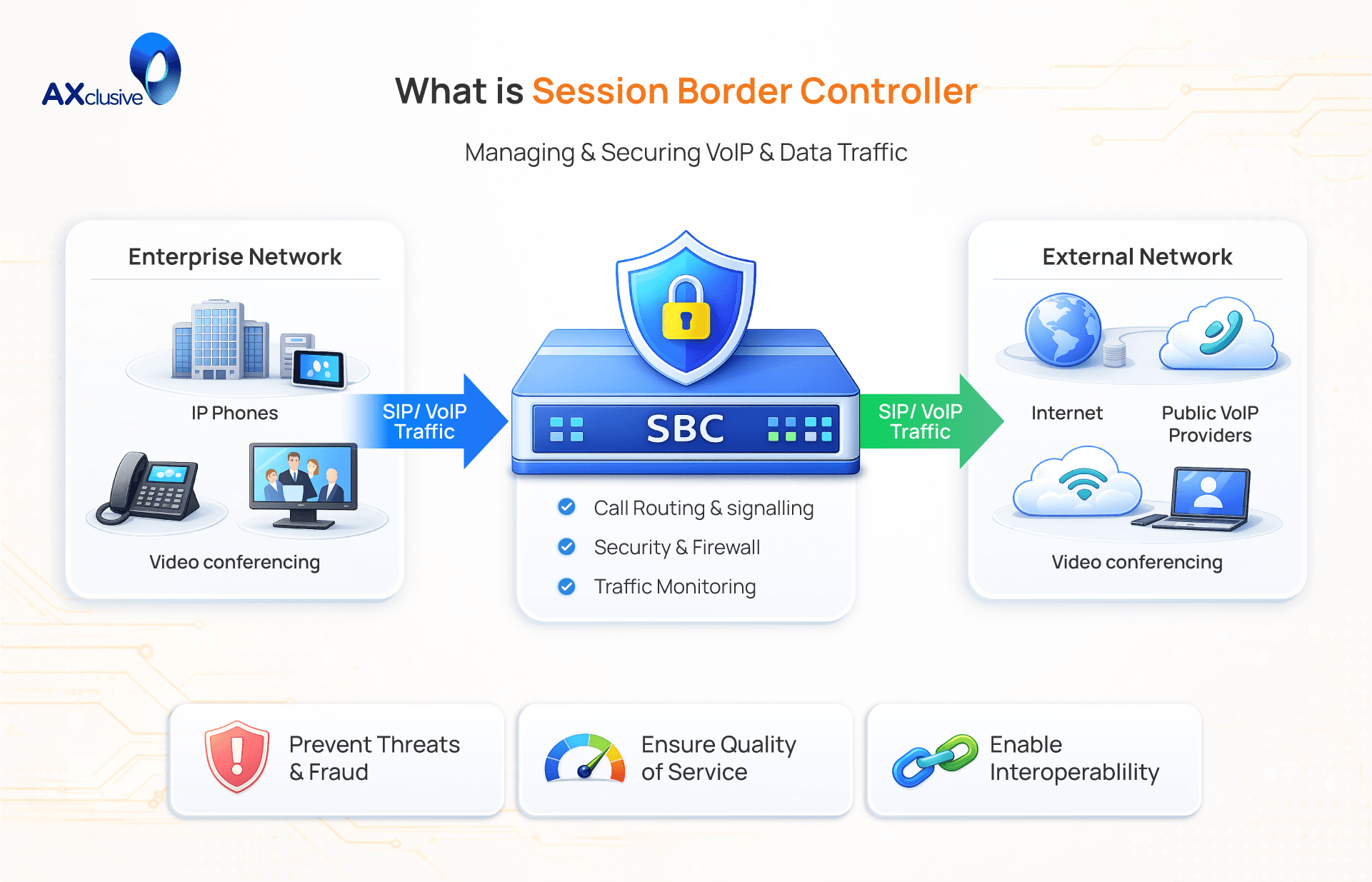
A Session Border Controller is a dedicated network security appliance designed to monitor, regulate, and protect live IP communication streams. Stationed strategically at the boundary between a private corporate network and external service providers, this technology acts as a specialized firewall for interactive media. While initially developed to safeguard voice over IP telephone systems, modern controllers now regulate all forms of real time communication, including digital video meetings, instant messaging, and multimedia collaboration sessions.
How Session Border Controllers Work
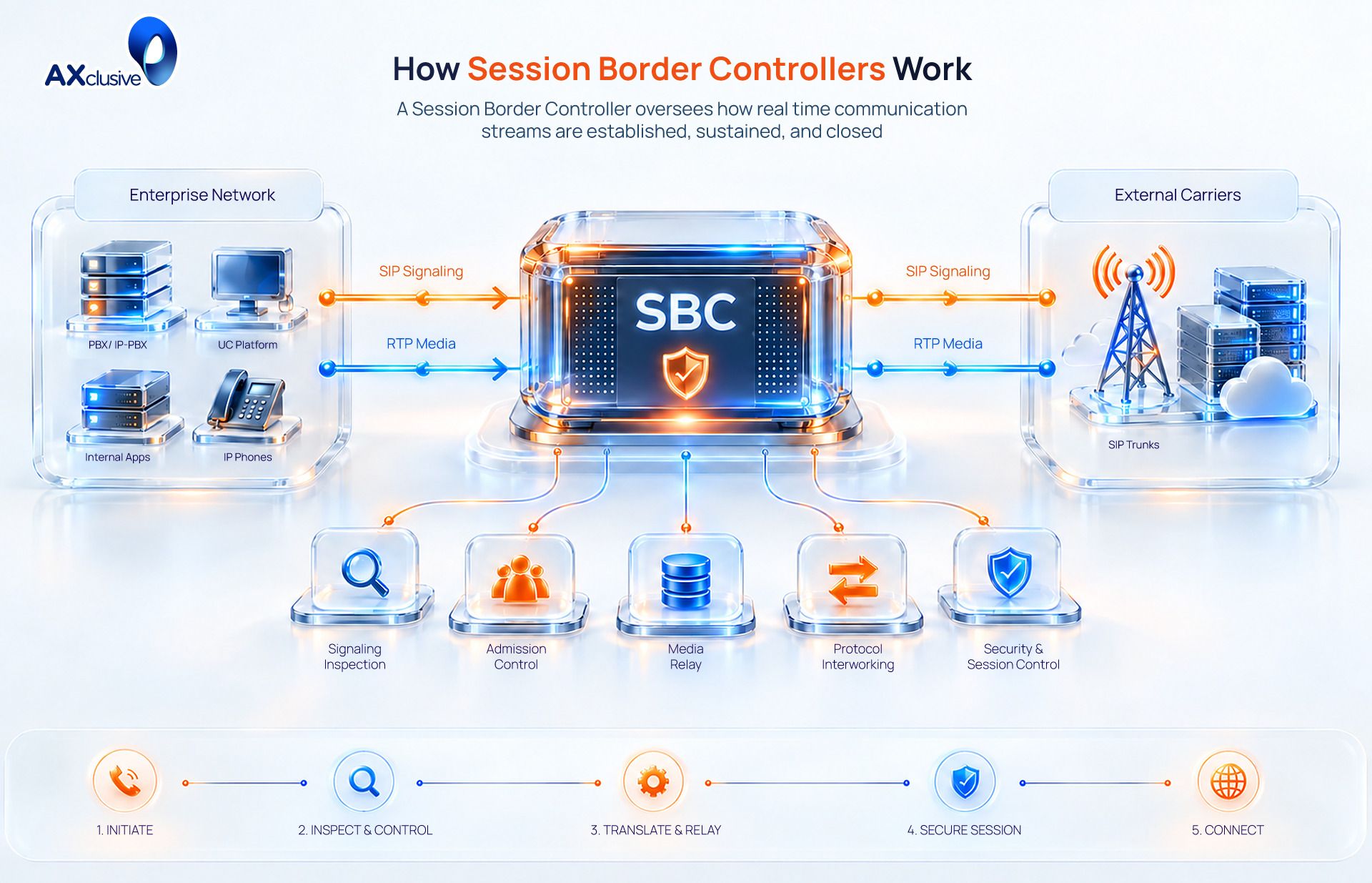
Positioned directly at the boundary between internal enterprise systems and external carriers, a Session Border Controller oversees how real time communication streams are established, sustained, and closed. In most SIP architectures, it operates as a back to back user agent. This design splits a single connection into two completely separate call legs, allowing the system to independently monitor, inspect, and manipulate both ends of the conversation.
The operational lifecycle follows these five core stages:
- Signaling Inspection and Validation: The controller intercepts all initial SIP requests, scanning them to filter out malformed data packets, unauthorized access attempts, and potential cyber threats before they reach the internal network.
- Capacity and Admission Control: It acts as an intelligent gatekeeper, checking current network bandwidth and active call limits. If resources are insufficient to maintain high quality, the system denies or reroutes the request to prevent network congestion.
- Media Relay and Stream Optimization: The appliance manages the Real Time Transport Protocol data, overcomes network address translation barriers, transcodes incompatible audio or video codecs on the fly, and continuously monitors stream quality.
- Protocol Interworking: Because different telecommunications carriers and corporate software often speak slightly different digital dialects, the controller translates incompatible signaling formats so disparate systems can communicate flawlessly.
- Clean Session Teardown: When a call concludes, the controller terminates both legs of the connection, records detailed logs for administrative billing or security auditing, and instantly frees up network capacity for new users.
Primary Classifications of Session Border Controllers
Session Border Controllers are primarily categorized through two practical lenses: their structural architecture and their operational scope. Evaluating these distinctions ensures an organization deploys the exact capacity required for its communication network.
Classification by Architecture
- Dedicated Hardware Units: Physical rackmount appliances installed on premises with independent processors. Because they utilize isolated, non shared computing resources, these units provide unmatched stability and deterministic performance for mission critical facilities.
- Virtual Software Platforms: Pure software solutions designed to run on existing enterprise hypervisors, standard servers, or virtual machines. This model eliminates dedicated hardware expenses, enhances operational flexibility, and makes capacity upgrades effortless.
- Cloud Hosted Deployments: Virtual controllers running inside public or private cloud environments. This framework eliminates all physical on site maintenance while delivering elastic, instant scaling to manage unpredictable call volume fluctuations.
Classification by Operational Scope
- Enterprise SBCs: Engineered specifically for businesses and corporate campuses. Their primary function is to create a secure, policy controlled perimeter that links internal enterprise phone networks to external SIP trunking providers or cloud voice platforms.
- Service Provider SBCs: Built at massive scale for telecommunications carriers, major ISPs, and large scale operators. These heavy duty systems are optimized to handle millions of simultaneous multimedia sessions while managing complex routing and billing across vast multi network infrastructures.
Common Practical Applications of Session Border Controllers
Session Border Controllers solve critical security, interoperability, and routing challenges across enterprise voice networks. The primary practical applications include:
- SIP Trunking Demarcation: Acts as the secure boundary gateway connecting an internal corporate phone system to external telecom carriers. It manages authentication, prevents cyber threats, and oversees traffic handoffs whether deployed on premises or as a cloud hosted service.
- IP Contact Center Routing: Directs high volume call traffic across distributed customer support facilities. Migrating legacy systems to an all IP architecture eliminates expensive carrier transfer fees and enables intelligent call distribution between multi site agent teams.
- Securing Cloud Communications: Protects and governs access to remotely hosted telephony, video conferencing, and unified communications platforms, ensuring real time multimedia sessions remain encrypted across the public web.
- Remote Workforce Connectivity: Safely extends corporate telephone extensions to remote employees, mobile staff, and satellite branch offices, allowing staff to communicate securely over the internet without exposing internal servers.
- Unifying Fragmented Systems: Merges disparate legacy PBX platforms and modern communication tools into a single integrated network featuring standardized dial plans, uniform features, and centralized routing policies.
- Carrier Interconnect Security: Telecommunications operators utilize high capacity controllers to shield their core infrastructure, policing data flow across customer access networks, core routing nodes, and multi carrier interconnect points.
Benefits of Session Border Controllers
Deploying a Session Border Controller (SBC) provides a strategic advantage by transforming your voice network into a secure, efficient, and reliable communication platform. The benefits extend beyond simple call routing to deliver enhanced security, significant cost savings, and a superior user experience, ensuring your infrastructure is both compliant and future-proof.
- Advanced Security: Blocks DDoS attacks, stops toll fraud, and encrypts calls (TLS/SRTP).
- Cost Savings: Slashes telecom bills via Least-Cost Routing (LCR) and reduces hardware needs.
- Maximum Flexibility: Bridges legacy PBX with cloud platforms (e.g., MS Teams) and secures remote workers.
- Strict Compliance: Meets regulatory standards (HIPAA, GDPR) with native call logging and auditing.
- Premium Quality: Prioritizes voice traffic (QoS) for clear audio and ensures 99.99% uptime via instant failover.
Why Do VoIP Calls Sometimes Sound Choppy?
Find out What Is Network Jitter and how it affects voice quality and real-time communication.
Session Border Controllers in the Singapore Context
Singapore’s position as Asia-Pacific’s telecommunications and financial hub creates unique requirements for enterprise communications:
Regulatory Environment
The Infocomm Media Development Authority (IMDA) mandates specific security and resilience standards for telecommunications services. SBCs deployed in Singapore must support lawful intercept capabilities, maintain comprehensive audit logs, and implement security controls aligned with Cybersecurity Act requirements.
Financial Services Sector
With over 150 financial institutions headquartered in Singapore, the banking and investment sector demands robust, compliant communications infrastructure. Monetary Authority of Singapore (MAS) Technology Risk Management Guidelines specifically address communications security, requirements that properly configured SBCs inherently satisfy.
Multi-National Operations
Singapore serves as regional headquarters for many multinational corporations, requiring communications infrastructure that supports diverse geographic operations. SBCs enable cost-effective international connectivity while maintaining centralized security policies and ensuring consistent user experiences across Asian, European, and American offices.
Smart Nation Initiatives
Singapore’s digital transformation agenda emphasizes secure, reliable digital infrastructure. Enterprise communications leveraging SBC technology align with Smart Nation objectives by enabling secure remote work, supporting digital service delivery, and providing the resilient infrastructure required for critical business operations.
In conclusion, the Session Border Controller is no longer an optional component but a foundational element of any modern enterprise voice network. It provides the essential security, interoperability, and quality of service management required to operate reliably in a converged IP environment. This guide from Axclusive delivers the insights needed to leverage SBCs effectively, ensuring your communications remain secure, compliant, and ready for the future.
Contact us today to learn how a Session Border Controller can secure and optimise your VoIP infrastructure for enterprise performance.