
What Is MPLS? Complete Guide to Multiprotocol Label Switching
To build a fast and stable corporate network, IT leaders must understand what is mpls. Multiprotocol Label Switching routes data along predetermined paths to ensure rock solid reliability for voice, video, and critical applications. Join Axclusive ISP in the article below to explore how this technology powers modern enterprise connectivity.
What Is MPLS?
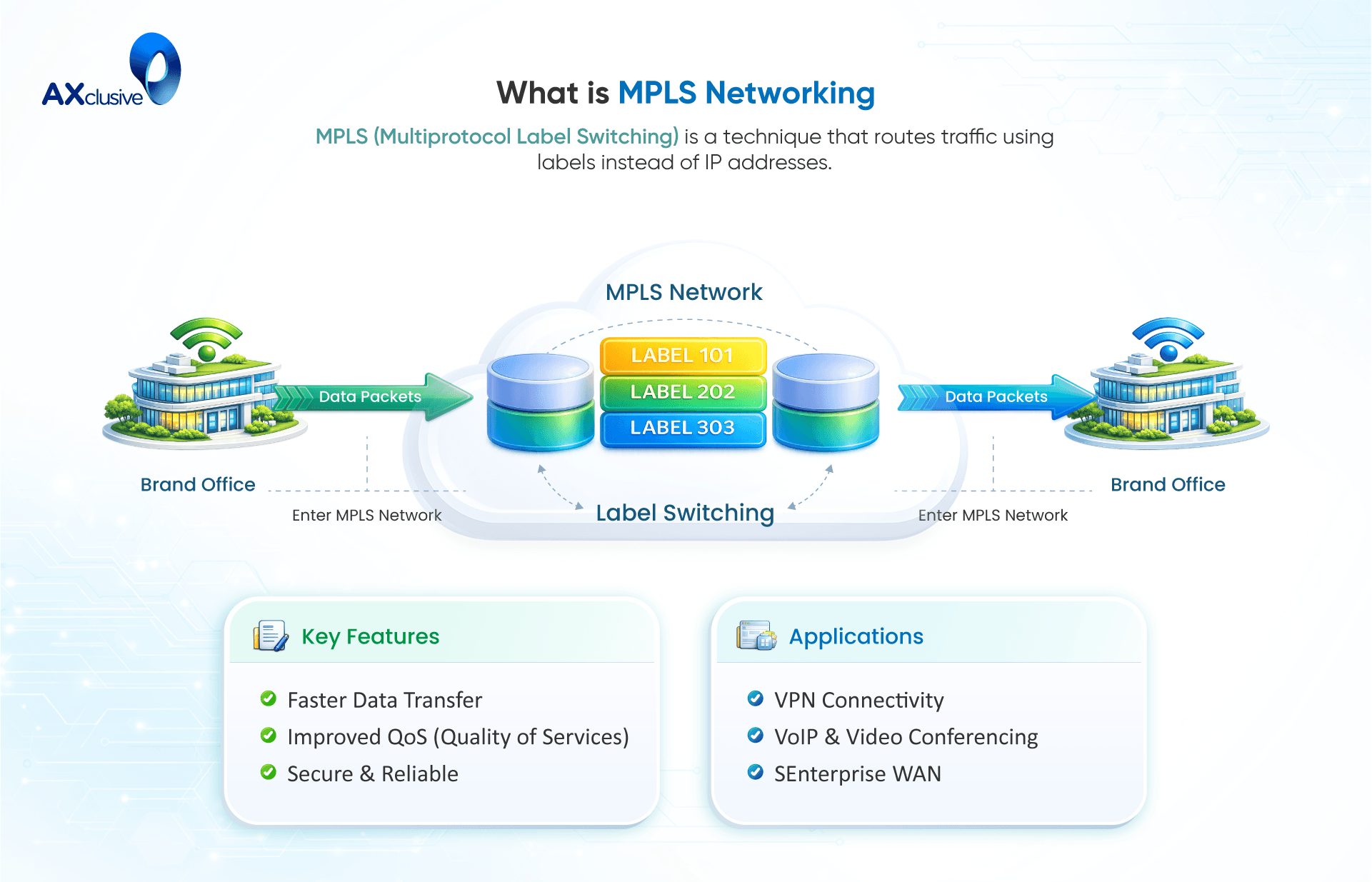
Multiprotocol Label Switching is an advanced data transport technique engineered to streamline and accelerate traffic flow across enterprise wide area networks. While standard internet routing forces every intermediate router to inspect an entire IP packet header to determine the next stop, MPLS assigns short, predetermined labels to incoming data packets. Routers simply read these numerical tags to forward information instantly along a pre configured path without performing repetitive routing table lookups. Operating at Layer 2.5 of the OSI model, this technology bridges the switching speed of the data link layer with the routing intelligence of the network layer, delivering exceptionally reliable, low latency connections for geographically distant branch offices.
Want to learn how modern data centers and cloud networks achieve scalable Layer 2 connectivity? Explore our guide on What Is VXLAN to understand how VXLAN supports network virtualization, segmentation, and large-scale infrastructure deployment.
How MPLS Works in a Network
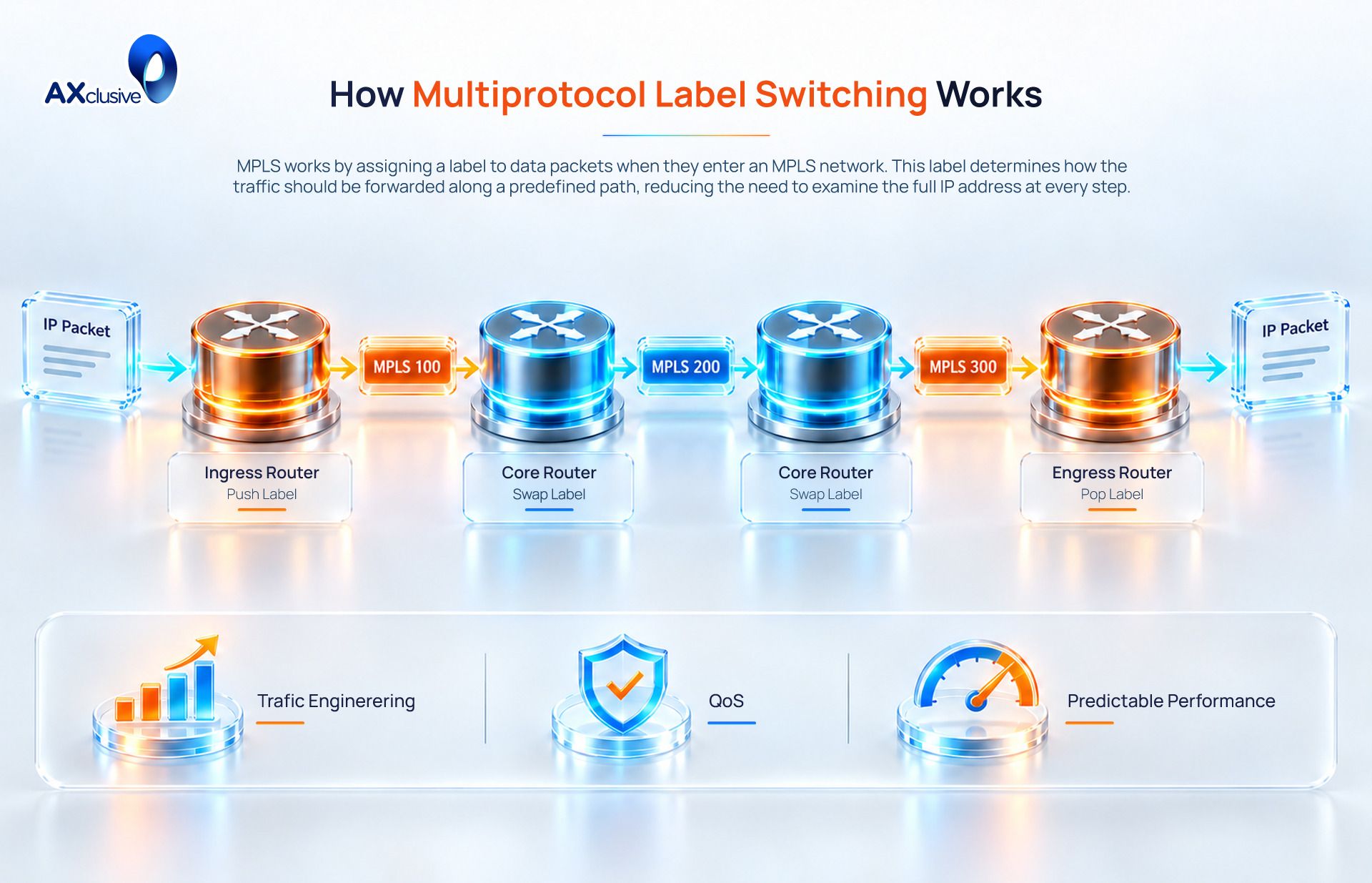
MPLS works by assigning a label to data packets when they enter an MPLS network. This label determines how the traffic should be forwarded along a predefined path, reducing the need to examine the full IP address at every step.
- MPLS Label Assignment: When traffic enters the network, packets with similar forwarding requirements are grouped and assigned an MPLS label. The label contains the information needed to guide the packet through the network.
- MPLS Packet Forwarding: As the packet moves through the MPLS network, routers read and update its label to determine the next forwarding point. This continues until the packet reaches the edge of the MPLS network, where the label is removed.
- MPLS Traffic Management: By controlling the paths used by different types of traffic, MPLS can provide more predictable network performance and support Quality of Service (QoS). This is particularly useful for business applications such as voice, video, and connectivity between multiple locations.
Key Benefits of MPLS for Business Networks
MPLS provides several advantages for organizations that require reliable, scalable, and flexible network connectivity.
- Guaranteed Performance Consistency: Data travels along predetermined private corridors rather than navigating the unpredictable public web. This dedicated routing ensures deterministic speeds, eliminates latency spikes, and maintains unwavering connection stability between distant corporate facilities.
- Granular Quality of Service: Administrators can categorize incoming traffic streams into distinct priority tiers. Allocating dedicated bandwidth to time sensitive communication tools ensures that real time audio meetings, video conferencing, and business critical operations experience zero buffering or packet loss.
- Intelligent Traffic Engineering: Network managers gain the power to manually or dynamically steer data around congested physical circuits. This dynamic balancing maximizes available network capacity and actively prevents bottleneck slowdowns during peak operational hours.
- Seamless Transport Flexibility: True to its multiprotocol design, the architecture operates independently of underlying physical transport mediums. It effortlessly encapsulates and transports diverse data payloads across various access technologies, making it exceptionally adaptable for complex hybrid environments.
- Effortless Multi Site Expansion: The framework easily scales to accommodate enterprise growth. Adding new regional headquarters, branch offices, or remote cloud data centers into the existing private ecosystem requires minimal architectural redesign.
- Native Virtual Private Network Isolation: By utilizing specialized label stacking techniques, service providers can partition a single physical backbone into completely isolated virtual private domains. This delivers ironclad privacy, keeping internal company communications safely insulated from external digital threats.
Common Business Applications of MPLS Networks
Multiprotocol Label Switching remains a dominant enterprise networking technology because it delivers deterministic performance and complete traffic isolation. Network architects and internet service providers deploy this protocol to solve three primary connectivity challenges:
- Private Enterprise Wide Area Networks: MPLS serves as the trusted standard for unifying geographically dispersed corporate branches, regional office campuses, and primary data centers into a seamless private network. By routing data entirely away from the public internet, enterprises secure predictable latency, eliminate jitter, and maintain guaranteed uptime for mission critical internal software.
- Carrier Level Virtual Private Networks: Major telecommunications providers utilize MPLS label stacking to safely divide a single physical backbone infrastructure among multiple corporate clients. Through implementations like Layer 3 VPNs, carriers keep sensitive customer data streams completely isolated from one another without having to lay separate, expensive physical fiber lines for every business.
- Intelligent Traffic Engineering: Standard IP routing blindly forces packets along the shortest physical path, which frequently creates severe bottlenecks on primary circuits. MPLS allows network administrators to override default routing behaviors, actively steering heavy data traffic away from congested links and redirecting it across underutilized paths to maximize overall network capacity.
MPLS Advantages and Challenges
MPLS provides businesses with greater control over how traffic moves across a WAN. It can deliver predictable connectivity and traffic prioritization, but it may also involve higher costs and less deployment flexibility than internet-based alternatives.
Core Advantages
- Structured Routing Pathways: Directing packets along predefined circuits guarantees dependable transit speeds and consistent network performance.
- Isolated Traffic Channels: Diverse operational workloads and corporate departments can be securely segregated across private virtual networks.
- Adaptive Route Control: Network engineers can manually designate data paths to maximize available bandwidth and actively prevent system congestion.
- Tiered Quality of Service: Essential communication tools such as voice calls and video feeds receive top tier transmission priority over general data.
- Broad Protocol Compatibility: The underlying infrastructure easily carries multiple types of network data without requiring distinct physical systems.
Primary Challenges
- Premium Bandwidth Expenses: Dedicated private lines carry a substantially higher cost per megabit than commercial broadband or internet connections.
- Extended Setup Timelines: Ordering, configuring, or modifying physical circuits requires lengthy administrative coordination with telecommunications vendors.
- Heavy Carrier Reliance: Infrastructure scaling, route adjustments, and issue resolution remain largely dependent on the external service provider.
- Inefficient Cloud Backhauling: Traditional routing models often push web traffic back through centralized hubs, introducing unnecessary latency for modern cloud applications.
MPLS Connectivity Alternatives
MPLS alternatives are networking options that replace or complement MPLS to reduce cost and increase flexibility. They are commonly used to support cloud access, remote users, and modern application traffic.
MPLS vs. Internet Connectivity
MPLS and public Internet connectivity are both widely used options for enterprise networks, but they are designed to meet different operational requirements. While the Internet offers flexibility and lower cost, MPLS focuses on controlled performance and predictable service delivery. Below is a clear comparison that highlights the key differences between the two approaches.
- Internet connectivity relies on multiple carriers, public routing paths, and upstream IP transit agreements, where traffic control is not centralized like a private MPLS backbone.
- Traffic prioritization: MPLS networks support traffic classification and prioritization, ensuring critical data receives guaranteed handling. Internet connections treat most traffic equally, with no native quality-of-service guarantees.
- Support for voice and video: MPLS is commonly used for voice and video workloads because it provides consistent latency and packet delivery. Internet-based connectivity may experience jitter and packet loss, which can affect real-time communication quality. To better understand how lost packets can impact application performance and user experience, learn What Is Packet Loss and what commonly causes it in a network.
- Service Level Agreements: Dedicated private circuits feature strict, legally binding guarantees covering uptime, latency thresholds, and packet delivery. In contrast, standard internet connections offer far less stringent commitments that fluctuate based on the provider and service tier.
- Cost Structure: Dedicated private infrastructure commands premium pricing due to guaranteed performance tiers and active carrier oversight. Conversely, public internet access remains significantly more affordable and expands on demand with minimal financial friction.
- Security Model: Private routing operates across isolated carrier lines completely removed from external public traffic, drastically minimizing cyber exposure. Standard internet connectivity traverses shared public pathways, demanding supplementary encryption and security protocols to shield sensitive data in transit.
MPLS vs. VPN
MPLS and virtual private networks (VPNs) are both used to connect users and sites securely, but they are built on different network models and serve different operational goals. MPLS focuses on controlled routing and performance, while VPNs emphasize encryption and secure access over public networks. The key differences are outlined below.
- Network foundation: MPLS operates over a service provider’s private backbone with managed routing paths. VPNs run on top of the public internet and create a secure tunnel between endpoints.
- Performance and speed: VPN connections can use high-speed internet links at a lower cost, making them suitable for high-throughput use cases. However, performance depends on internet conditions. MPLS delivers more consistent latency and reliability due to controlled routing.
- Security approach: MPLS networks are logically isolated and use private routing, but encryption is not enabled by default. VPNs are designed around security and always use authentication and encryption to protect data over untrusted networks.
- Encryption and authentication: VPNs rely on established cryptographic methods and tunneling protocols to ensure confidentiality and data integrity. Even if traffic is intercepted, encrypted data remains unreadable. MPLS typically requires additional security layers to achieve the same level of protection.
- Data protection model: VPNs protect data through encrypted tunnels and user authentication, making unauthorized access difficult. MPLS relies on network isolation rather than encryption for data protection.
- Cost and deployment: VPN solutions are generally more cost-effective and easier to deploy, as they do not require dedicated infrastructure. MPLS involves higher costs due to provider-managed circuits and infrastructure commitments.
MPLS vs. IPsec
MPLS and IPsec address different aspects of enterprise connectivity. MPLS is designed to provide controlled routing and predictable performance over private networks, while IPsec focuses on securing data transmission across public networks through encryption and authentication. The main distinctions between the two are outlined below.
Primary Objective: Dedicated label routing delivers private, provider managed connectivity along pre determined physical paths. Conversely, IPsec serves as a cryptographic framework designed to construct secure VPN tunnels across the open public internet.
Data Encryption: Private carrier circuits do not apply encryption by default, relying instead on physical infrastructure isolation. IPsec actively encrypts every individual data packet and authenticates sender identity, guaranteeing complete confidentiality in transit.Operational Costs: Dedicated circuits demand significant ongoing financial investments for managed telecommunications contracts. IPsec utilizes affordable standard internet lines but introduces heavy cryptographic processing strain on local firewalls and requires ongoing tunnel configuration as the enterprise expands.Threat Exposure: Private lines depend on network isolation, meaning data is only vulnerable to individuals with direct physical access to the wire. IPsec traffic travels across hostile public networks where interception attempts are frequent, though strong encryption keeps the payload unreadable.Network Stability: Dedicated enterprise connections back their performance with strict Service Level Agreements guaranteeing high uptime and minimal latency. IPsec remains entirely at the mercy of underlying internet links, exposing communications to unpredictable congestion and packet loss.Quality of Service: Label switched circuits natively enforce end to end bandwidth prioritization for latency sensitive voice and video feeds. IPsec can prioritize packets at the edge router, but transmission stability is ultimately degraded once data enters the unpredictable public web.
Primary Objective: MPLS delivers private, provider managed connectivity along pre determined physical paths. Conversely, IPsec serves as a cryptographic framework designed to construct secure VPN tunnels across the open public internet.
- Data Encryption: Private carrier circuits do not apply encryption by default, relying instead on physical infrastructure isolation. IPsec actively encrypts every individual data packet and authenticates sender identity, guaranteeing complete confidentiality in transit.
- Operational Costs: Dedicated circuits demand significant ongoing financial investments for managed telecommunications contracts. IPsec utilizes affordable standard internet lines but introduces heavy cryptographic processing strain on local firewalls and requires ongoing tunnel configuration as the enterprise expands.
- Threat Exposure: Private lines depend on network isolation, meaning data is only vulnerable to individuals with direct physical access to the wire. IPsec traffic travels across hostile public networks where interception attempts are frequent, though strong encryption keeps the payload unreadable.
- Network Stability: Dedicated enterprise connections back their performance with strict Service Level Agreements guaranteeing high uptime and minimal latency. IPsec remains entirely at the mercy of underlying internet links, exposing communications to unpredictable congestion and packet loss.
- Quality of Service: Label switched circuits natively enforce end to end bandwidth prioritization for latency sensitive voice and video feeds. IPsec can prioritize packets at the edge router, but transmission stability is ultimately degraded once data enters the unpredictable public web.
Primary Objective: Dedicated label routing delivers private, provider managed connectivity along pre determined physical paths. Conversely, IPsec serves as a cryptographic framework designed to construct secure VPN tunnels across the open public internet.
Data Encryption: Private carrier circuits do not apply encryption by default, relying instead on physical infrastructure isolation. IPsec actively encrypts every individual data packet and authenticates sender identity, guaranteeing complete confidentiality in transit.Operational Costs: Dedicated circuits demand significant ongoing financial investments for managed telecommunications contracts. IPsec utilizes affordable standard internet lines but introduces heavy cryptographic processing strain on local firewalls and requires ongoing tunnel configuration as the enterprise expands.Threat Exposure: Private lines depend on network isolation, meaning data is only vulnerable to individuals with direct physical access to the wire. IPsec traffic travels across hostile public networks where interception attempts are frequent, though strong encryption keeps the payload unreadable.Network Stability: Dedicated enterprise connections back their performance with strict Service Level Agreements guaranteeing high uptime and minimal latency. IPsec remains entirely at the mercy of underlying internet links, exposing communications to unpredictable congestion and packet loss.Quality of Service: Label switched circuits natively enforce end to end bandwidth prioritization for latency sensitive voice and video feeds. IPsec can prioritize packets at the edge router, but transmission stability is ultimately degraded once data enters the unpredictable public web.
MPLS vs. SD-WAN
MPLS and SD-WAN are both used to build wide area networks, but they are based on different architectural principles. MPLS relies on provider-managed private circuits, while SD-WAN uses software-based control to route traffic across multiple link types. The key differences are outlined below
- Routing Logic and Traffic Control: SD WAN uses centralized software policies to steer application data dynamically across available links based on real time network conditions. In contrast, traditional private circuits rely on static, predetermined pathways programmed directly by the service provider.
- Bandwidth Aggregation and Scalability: A software defined approach aggregates multiple connections, including commercial broadband, fiber, and cellular links, to multiply available capacity instantly. Scaling dedicated carrier lines requires ordering and provisioning new physical circuits, which dramatically inflates costs and delays deployment for months.
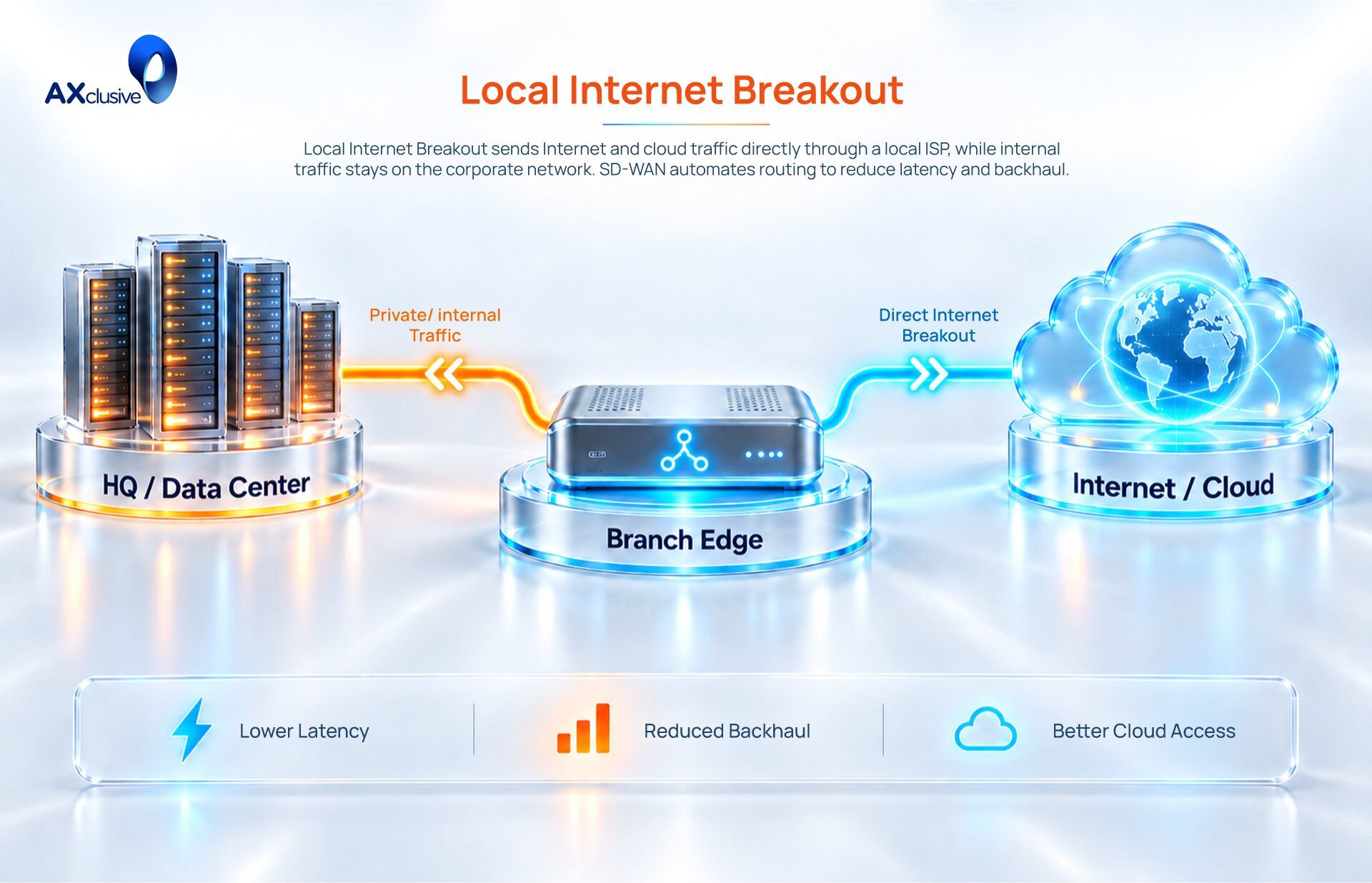
- Direct Cloud and Internet Reach: SD WAN permits remote branches to connect directly to public cloud platforms and web services without unnecessary detours. Legacy circuit architectures force traffic through a rigid hub and spoke model, routing every request to a central corporate headquarters before granting web access.
- Network Backhauling Reduction: By establishing direct pathways between branch offices and cloud applications, modern software overlays completely eliminate network tromboning. The traditional circuit model constantly backhauls everyday web traffic to central data centers, wasting expensive private capacity and creating noticeable latency.
- Total Cost of Ownership: A software driven network slashes recurring operational expenses by offloading non critical data onto affordable commercial internet links. Dedicated private infrastructure commands premium monthly pricing due to dedicated physical lines and strict performance guarantees.
- Security Framework: Dedicated circuits secure enterprise data through private physical isolation away from the public web. SD WAN assumes the underlying transport could be hostile, deploying automated end to end encryption and secure virtual tunnels across all active links.
Multiprotocol Label Switching (MPLS) plays an important role in enterprise networking where performance, reliability, and traffic control matter. Through an introductory article by Axclusive on MPLS, the technology is presented as a strategic connectivity solution that enables predictable performance, optimized traffic flow, and stable communication for complex enterprise network environments.
A resilient network starts with dependable connectivity. See how leased line service can support greater availability for critical business operations.