
What Is Blackhole Routing? Benefits and Limitations
When data packets mysteriously vanish without reaching their destination, your network has likely encountered a blackhole internet event. Join Axclusive ISP in the article below to explore what causes these digital voids.
What Is Blackhole Routing?
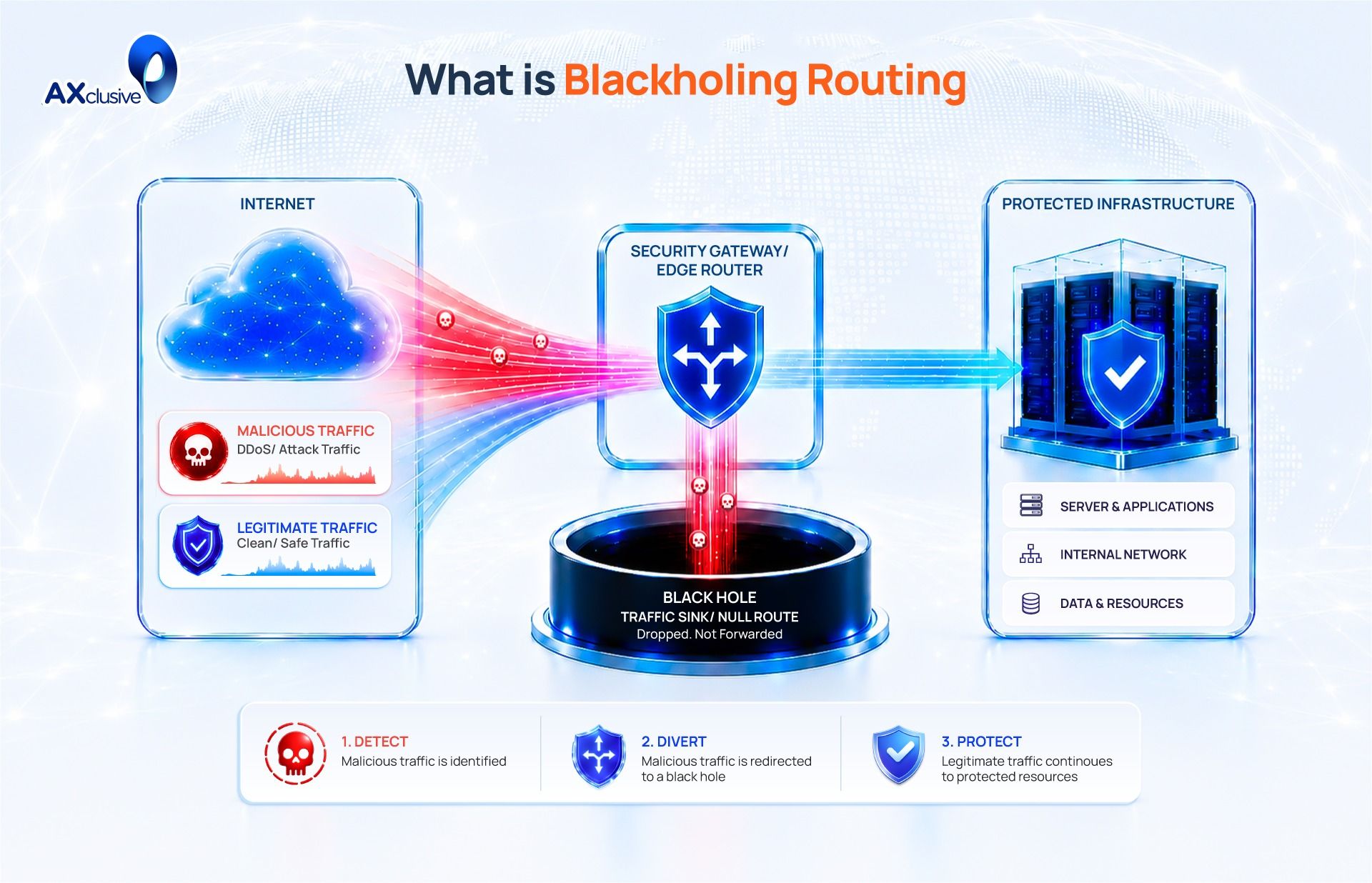
Blackhole Routing is a network mitigation technique that redirects traffic targeting a specific IP address or network to a null route, where the traffic is dropped before reaching its destination. It can help protect the wider network during a DDoS attack by preventing excessive traffic from consuming network resources. However, because legitimate traffic may also be discarded, blackhole routing is generally used as a temporary measure when maintaining the stability of the broader network takes priority over keeping the targeted service accessible.
How does blackhole routing work?
DDoS blackhole routing works by directing selected network traffic to a null route, where packets are discarded before they can consume resources on the targeted infrastructure. Network operators can apply different routing and filtering methods depending on the scale and characteristics of an attack:
- Static Blackhole Routing manually drops traffic associated with a specified source or destination IP address.
- BGP Blackholing advertises a blackhole route through BGP, allowing participating routers to discard traffic destined for the targeted IP.
- Remote Triggered Black Hole Filtering (RTBH) enables more targeted traffic dropping for specific hosts or network prefixes.
- BGP FlowSpec provides more granular filtering by defining traffic characteristics such as IP addresses, ports, and protocols.
- IP-Based Filtering blocks traffic associated with identified malicious sources or targeted destinations.
Benefits and Limitations of Blackhole Routing
Benefits
- Rapid Attack Containment: Blackhole routing can quickly stop large volumes of DDoS traffic from reaching the targeted infrastructure.
- Protects Network Bandwidth: Dropping attack traffic helps prevent excessive bandwidth consumption and reduces congestion across the wider network.
- Protects Other Network Services: Isolating the targeted destination can help prevent a DDoS attack from affecting other systems and services on the same network.
Limitations
- Legitimate Traffic May Be Blocked: Blackhole routing can discard genuine user traffic along with malicious traffic.
- Targeted Services May Become Unavailable: Because traffic is intentionally dropped, users may temporarily lose access to the affected website or service.
- Best Used as a Temporary Measure: Blackholing is generally more suitable for containing severe attacks than providing precise, long-term DDoS mitigation.
Dropping attack traffic can protect the wider network, but effective protection requires more than blackholing alone. Learn What Is DDoS Protection and how different detection and mitigation techniques work together to defend network infrastructure.
Common Factors Behind Internet Blackhole Routing
When data packets vanish without a trace before reaching their destination, the network is experiencing a blackhole effect. This issue is similar to standard packet loss but often occurs without any error notification sent back to the source. Below are the primary reasons these digital voids occur.
Prepare your infrastructure before malicious traffic becomes downtime. See how our DDoS Protection service helps keep critical services available during an attack.
Routing path disruptions
The most frequent cause of missing data happens directly at the routing level. If administrators accidentally misconfigure routers or if routing tables contain critical errors, the system sends data packets into a null route. Once trapped in this incorrect pathway, the information is permanently lost.
Unreachable IP destinations
Network directories and DNS records sometimes store IP addresses that are outdated, invalid, or simply no longer exist. When a system attempts to send information to these dead addresses, the data has nowhere to go. Because there is no active server to reject the request, the data silently drops into a void.
Cyberattack related traffic filtering
Sometimes a blackhole is completely intentional. Strict firewalls and stealth ports often silently discard packets from unverified sources to protect the system. Additionally, malicious hackers can purposely manipulate routing tables to trick networks into sending traffic down a fake path, trapping the data to disrupt communications.
Network infrastructure breakdowns
Physical hardware plays a massive role in data transmission. If core network devices like switches, routers, or main servers experience firmware failures or electronic malfunctions, they might randomly delete data packets before forwarding them. Upgrading or replacing faulty equipment is usually required to fix this issue.
Environmental interference
Wireless data transmission is highly sensitive to extreme external conditions. Severe weather events like heavy storms or high winds can physically disrupt the signal path between a transmitter and a receiver. The data leaves the source but is destroyed by the interference before it can arrive.
Signal and connectivity obstacles
Geographic locations heavily influence network stability. Rural areas or regions with challenging topography like mountains, massive lakes, or dense forests often lack proper infrastructure. These physical barriers weaken signal strength significantly, causing packets to drop constantly and creating persistent internet blind spots.
Effective Ways to Reduce Internet Blackholes Routing
While dropped data packets are a common challenge in complex networks, organizations can implement proactive administrative strategies to minimize these disruptions. By focusing on constant observation and strict protocol management, enterprises can keep their data flowing smoothly.
Real time traffic analysis
To stop data loss before it escalates, administrators must continuously observe network behavior. Deploying advanced monitoring tools allows IT teams to instantly detect unusual traffic spikes, data loops, or sudden packet drops. By constantly analyzing these patterns and keeping hardware firmware updated, teams can identify and resolve anomalies before they form massive communication voids.
Smarter route management
Since incorrect routing is a primary cause of lost data, maintaining clean and accurate pathways is critical. Network engineers must regularly audit routing tables to identify and remove dead IP addresses, null routes, and misconfigured paths. By optimizing these digital maps constantly, routers will always know exactly where to forward incoming traffic without error.
ICMP traffic configuration
The Internet Control Message Protocol is essential for diagnosing network health. Normally, a blackhole silently drops data without notifying anyone. By updating network policies to strictly enforce ICMP ping requests and require status responses, administrators force the system to report communication failures immediately. This clear visibility helps engineers quickly locate and fix the unresponsive segments of the network.
Ultimately, stopping data loss caused by a blackhole internet requires proactive routing optimization and hardware maintenance. Do not let misconfigured paths or extreme weather disrupt your connectivity. Take control of your network traffic today. Axclusive ISP hopes this guide empowers you to build a more resilient and reliable digital infrastructure.
What is blackholing in network security and how it helps mitigate malicious traffic and DDoS attacks. Contact us to strengthen your network protection with Axclusive ISP.