
What Is BGP? A Guide to Border Gateway Protocol
The internet depends on a complex routing system to move data reliably between networks around the world. At the centre of this system is Border Gateway Protocol BGP, the protocol responsible for directing traffic across the global internet.But what is BGP, and why does it matter for network performance and enterprise connectivity? Join Axclusive ISP as we explore how this critical routing protocol keeps the internet running.
What is BGP?
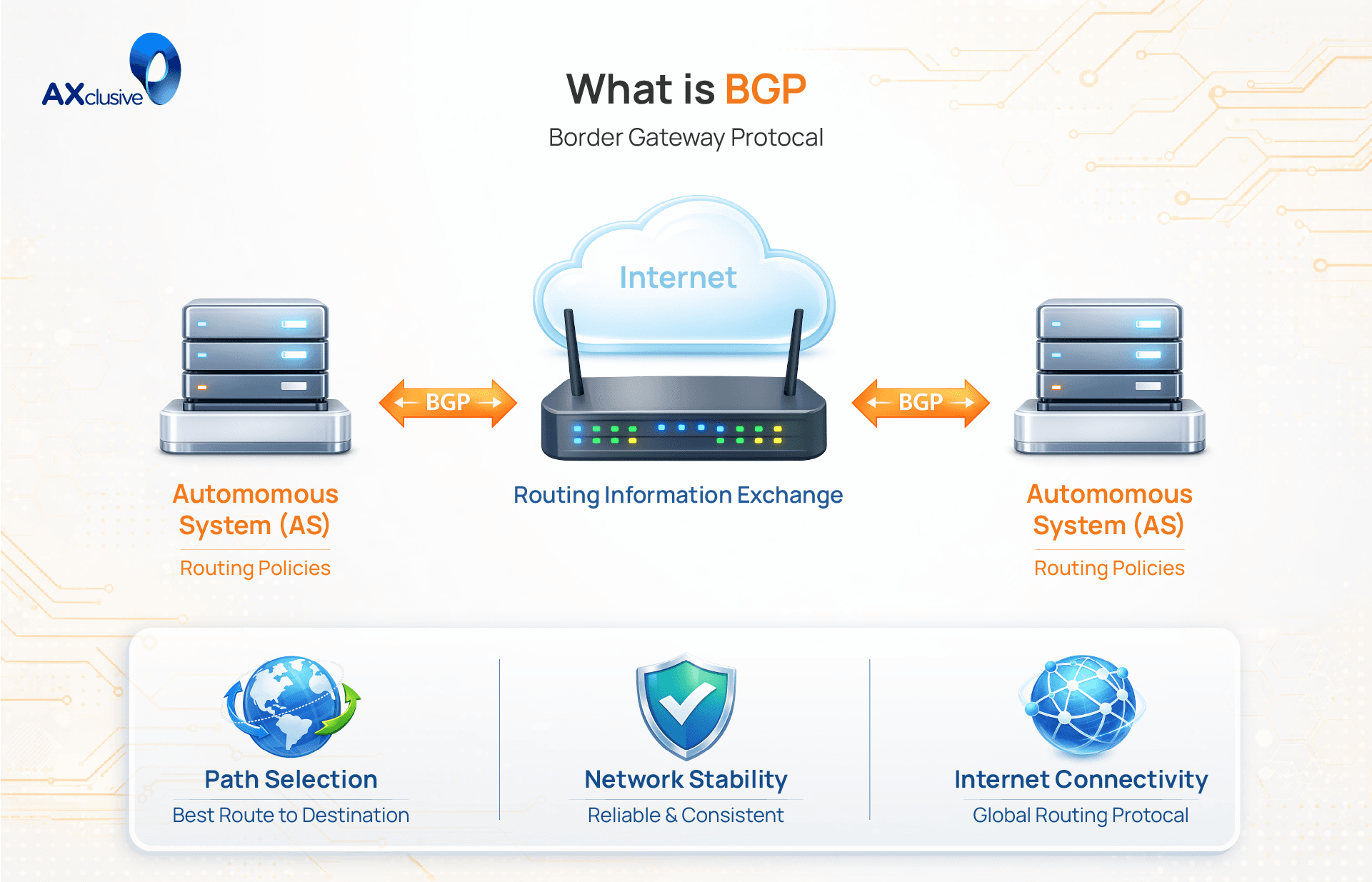
Border Gateway Protocol (BGP) is the routing protocol used to exchange network reachability information between autonomous systems (AS) across the Internet. It helps networks determine which available path should be used to route traffic from one network to another based on routing policies and path information. BGP plays a critical role in global Internet connectivity, allowing data to move efficiently between ISPs, data centers, cloud providers, and other interconnected networks.
Improve your business connectivity with dedicated internet access built to support secure, low-latency, and uninterrupted operations.
How Does BGP Work Across Networks
BGP works by allowing routers in different autonomous systems to exchange routing information and determine how traffic should reach its destination. Instead of relying only on the shortest route, BGP evaluates available paths based on network policies and route attributes.
- BGP Route Exchange: BGP peers share information about available network routes. When routes change or become unavailable, BGP sends updates so connected networks can adjust their routing decisions.
- BGP Path Selection: When multiple routes are available, BGP compares route attributes such as AS_PATH, LOCAL_PREF, MED, and NEXT_HOP to select the preferred path based on configured routing policies.
- BGP Route Updates: BGP maintains routing information as network conditions change. Rather than repeatedly sending the entire routing table, it primarily exchanges updates when routes are added, changed, or withdrawn.
Types of BGP
Border Gateway Protocol can be divided into two main types based on how routing information is exchanged between networks.
- External BGP (eBGP): eBGP exchanges routing information between different autonomous systems. It is commonly used to connect separate networks, such as an enterprise network communicating with an ISP or two service provider networks exchanging routes.
- Internal BGP (iBGP): iBGP distributes BGP routing information between routers within the same autonomous system. It helps routers inside the network maintain consistent routing information and determine how traffic should reach external destinations.
Key Functions of BGP
BGP performs several important functions to support reliable routing between networks.
- Establishes Peer Connections: BGP routers establish TCP sessions with trusted peers before exchanging routing information.
- Exchanges Route Information: BGP advertises available routes and withdraws routes that are no longer reachable.
- Maintains BGP Sessions: BGP regularly checks peer connections to ensure routing information can continue to be exchanged reliably.
Power your network with enterprise-grade IP Transit designed for speed, stability, and reliable global connectivity. Contact us to find the right solution for your business needs.
The Importance of BGP in Modern Networks
BGP plays an essential role in managing traffic across the internet backbone, allowing different networks to exchange routing information efficiently and maintain reliable global connectivity.
- Scalable Routing: BGP manages large numbers of routes across interconnected networks.
- Multihoming Support: Organizations can connect to multiple ISPs to improve network redundancy.
- Path Selection: BGP evaluates available routes and routing policies to determine the preferred path for traffic.
- Reliable Route Exchange: BGP uses TCP to maintain reliable communication between connected routers.
- Routing Control: Network operators can control how traffic enters and leaves their networks using BGP policies and attributes.
Want to learn how Redundant Routing helps improve network reliability and minimize downtime? Explore our guide on Redundant Routing to understand how businesses maintain stable connectivity during network disruptions.
Key Benefits of BGP for Network Routing
BGP provides several benefits that make it essential for ISPs, enterprise networks, and large-scale internet infrastructure.
- Scalable Network Routing: BGP can manage a large number of routes across complex networks. Route aggregation also helps reduce unnecessary routing information, making network expansion easier to manage.
- Greater Routing Control: Network administrators can use BGP policies and attributes to control how traffic enters and leaves their networks based on specific connectivity requirements.
- Improved Network Resilience: BGP supports multiple available network paths. When routing conditions change or a route becomes unavailable, alternative paths can be selected based on configured policies.
- Flexible Traffic Management: BGP gives network operators greater control over traffic flows. Techniques such as AS path prepending and BGP communities can influence route selection and help optimize inbound and outbound traffic.
Key Characteristics of BGP
Border Gateway Protocol is the standard for inter-domain routing due to a unique set of design characteristics that prioritize policy, scalability, and reliability over simple speed metrics. These features distinguish it from all other routing protocols.
Inter-Autonomous System Operation
BGP's primary design function is to facilitate communication between distinct Autonomous Systems (ASes). It is the only protocol used today to connect the thousands of independent networks that form the global internet, enabling them to exchange routing information and forward traffic to one another.
Next-Hop Routing Model
BGP operates on a next-hop basis. When a BGP router advertises a route, it includes the IP address of the next router (the "next hop") that should be used to reach that destination. This allows for simple and efficient forwarding decisions, as a router only needs to know the immediate next step in the path, not the entire end-to-end route.
Coordination Between BGP Peers
Within a single Autonomous System, Internal BGP (iBGP) ensures all routers have a consistent and complete view of external routes. This coordination is essential for making uniform routing decisions, preventing loops, and ensuring that outbound traffic follows the correct policy regardless of which edge router it exits.
Path-Based Routing Information
Unlike other protocols that use a simple cost metric, BGP makes decisions based on path information. Every route advertisement includes the AS_PATH attribute, which is a list of all Autonomous Systems the route has traversed. This provides a loop-free path vector and is a primary factor in the best-path selection process.
Policy-Driven Route Control
BGP is fundamentally a tool for policy enforcement. Administrators can use a rich set of attributes (like Local Preference, MED, and Communities) to influence the route selection process based on business requirements, such as cost, traffic agreements, or performance preferences, rather than just the shortest path.
TCP-Based Transport
BGP runs over the Transmission Control Protocol (TCP) on port 179. Using TCP provides a reliable, connection-oriented transport mechanism, guaranteeing that routing updates are delivered completely and in the correct order. This eliminates the need for the protocol to manage its own reliability and retransmission logic.
Bandwidth-Efficient Updates
BGP conserves network bandwidth by using a trigger-based update model. A BGP router sends routing updates only when a change in the network occurs (e.g., a path goes down or a new one becomes available). It does not send periodic, full routing table refreshes, which makes it highly efficient for managing the massive internet routing table.
CIDR Compatibility
BGP was designed to support Classless Inter-Domain Routing (CIDR). This allows it to work with variable-length subnet masks, enabling the efficient allocation and aggregation of IP address space. This capability is essential for managing the global IP address pool and keeping the internet's routing table a manageable size.
Built-In Security Support
While the base protocol has known vulnerabilities, BGP includes foundational support for security. This includes the ability to authenticate peering sessions between routers using a pre-shared key (MD5). This feature provides a basic layer of verification and serves as a platform for more advanced security frameworks like RPKI (Resource Public Key Infrastructure).
Border Gateway Protocol is the fundamental mechanism that underpins the global internet. By enabling thousands of independent Autonomous Systems to exchange routing information based on policy, BGP ensures that data travels efficiently and reliably across the world. A solid grasp of its principles is therefore essential for any network professional. This comprehensive guide from Axclusive provides the foundational knowledge needed to navigate the complexities of inter-domain routing, empowering you to build a more resilient and performant network.
Want to understand how BGP impacts your network performance? Contact us today to optimise your routing strategy and strengthen your enterprise connectivity.