
What Is an Ethernet Switch? Types, Features and Benefits
Ethernet switches play an essential part in enabling smooth and efficient communication between devices within a local network. By directing data traffic intelligently, an Ethernet switch helps improve network speed, stability, and overall performance. In this article, Axclusive ISP explores how Ethernet switches work in modern networking environments.
What is an Ethernet switch?
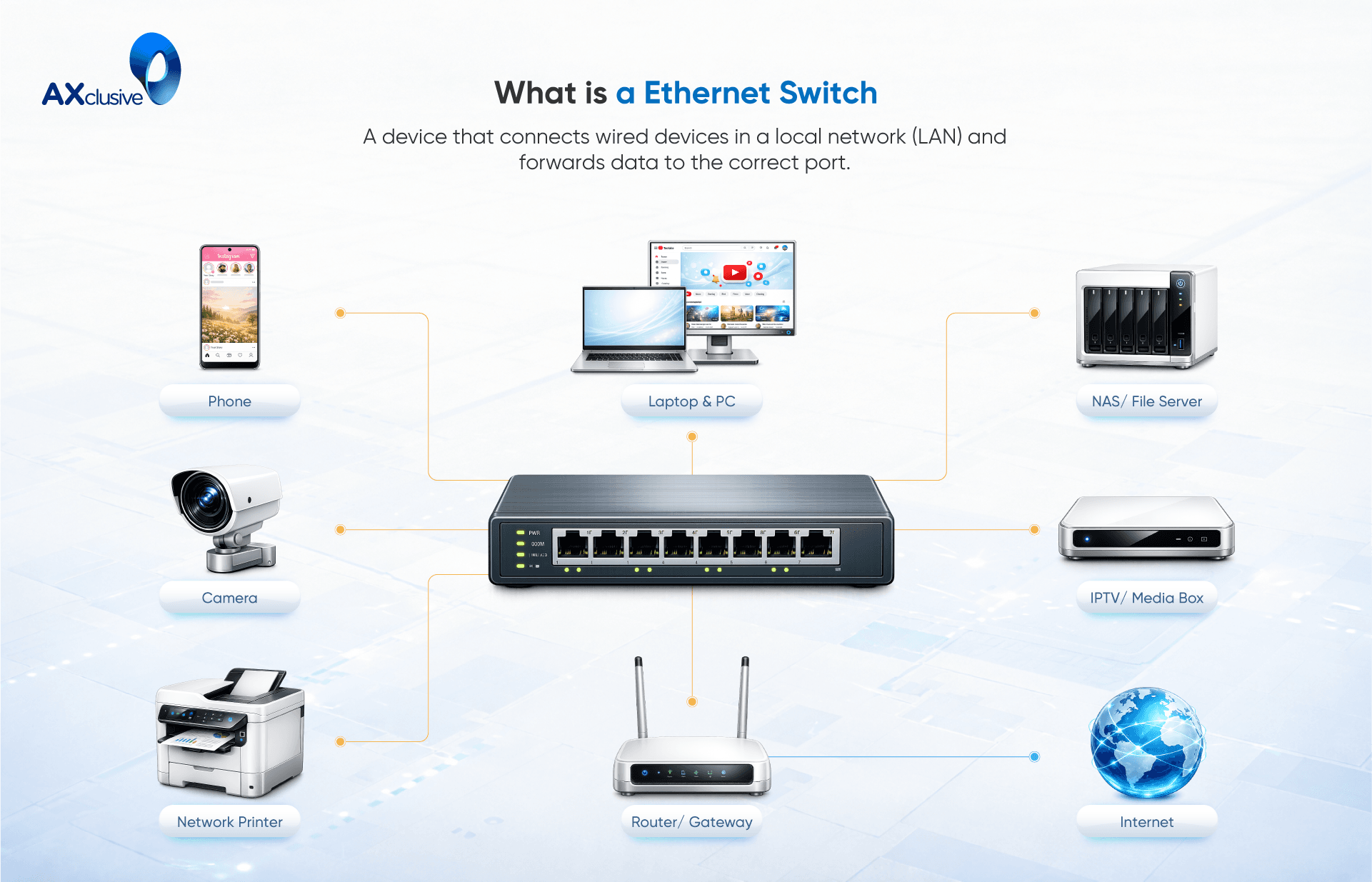
Ethernet switch is a network device that connects multiple wired devices within a local area network (LAN). It receives data from connected devices and forwards it to the appropriate destination through its Ethernet ports. By enabling computers, servers, printers, access points, and other network devices to communicate efficiently, Ethernet switches play an important role in building reliable and scalable business networks.
How do Ethernet switches work
An Ethernet switch manages communication between wired devices within a local area network (LAN). Devices such as computers, servers, printers, routers, and wireless access points connect to the switch through Ethernet ports.
When an Ethernet frame arrives, the switch reads the MAC address of the sending device and records it together with the connected port in its MAC address table. It then checks the destination MAC address to determine where the frame should be forwarded.
If the destination is already known, the switch sends the frame directly to the appropriate port instead of forwarding it to every connected device. If the destination is unknown, the switch initially forwards the frame through relevant ports to locate the destination and learns its location from subsequent traffic.
In larger networks, multiple Ethernet switches can be connected together. Traffic can then move between access, distribution, and core switches until it reaches the intended device. This approach enables Ethernet networks to scale from small office environments to large enterprise and data center networks.
Key Benefits of Ethernet Switch
Ethernet switching provides several benefits that improve the performance, flexibility, and scalability of business networks.
- Improved Network Performance: Switches forward traffic directly to the intended device, helping reduce unnecessary network traffic and congestion.
- Efficient Data Transmission: Ethernet switches support simultaneous data transmission and reception, allowing connected devices to use network bandwidth more efficiently.
- Easy Network Expansion: Businesses can add more devices or switches as network requirements grow, making Ethernet switching suitable for both small and large networks.
- Flexible Connection Speeds: Many switches can automatically determine the appropriate connection speed for each device, supporting equipment with different network capabilities.
- Device Interoperability: Ethernet follows widely adopted IEEE standards, allowing compatible devices and switches from different vendors to operate within the same network.
- Better Network Management: Managed Ethernet switches provide additional capabilities such as traffic monitoring, VLAN configuration, access control, and network segmentation.
Main Types of Ethernet Switches
Ethernet switches can be classified by how they are managed and the network functions they provide.
Managed and Unmanaged Switches
- Unmanaged Switches: Simple plug-and-play switches that require little or no configuration. They are commonly used in small offices and basic networks.
- Managed Switches: Provide greater control over network traffic, security, monitoring, VLANs, and other configurations. They are better suited to enterprise networks.
PoE Switches
Power over Ethernet (PoE) Switches: Carry both data and electrical power through the same Ethernet cable, making them useful for IP cameras, wireless access points, and VoIP phones.
Layer 2 and Layer 3 Switches
- Layer 2 Switches: Forward Ethernet frames using MAC addresses and are mainly used for communication within a LAN.
- Layer 3 Switches: Combine switching with routing capabilities, allowing traffic to move between different networks or VLANs.
Essential Features of Ethernet Switches
Modern Ethernet switches include a range of features that help businesses improve connectivity, performance, and network management.
- Power over Ethernet (PoE): Allows compatible devices such as IP cameras, VoIP phones, and wireless access points to receive both power and data through a single Ethernet cable.
- Different PoE Power Levels: PoE standards support different power requirements, from basic network devices to higher-powered equipment such as advanced wireless access points and video conferencing systems.
- High-Speed Ethernet: Gigabit Ethernet and faster technologies provide greater bandwidth for applications such as large file transfers, cloud services, video conferencing, and data-intensive workloads.
- High Port Density: Switches with multiple Ethernet ports allow businesses to connect more computers, servers, access points, cameras, and other network devices while supporting future expansion.
- VLAN Support: Virtual LANs allow administrators to separate devices and traffic into logical network segments, improving network organization, security, and traffic management.
- Quality of Service (QoS): QoS allows important traffic, such as voice and video, to receive higher priority when network resources are limited.
- Network Management: Managed switches can provide monitoring, configuration, access control, and troubleshooting capabilities, giving IT teams greater visibility and control over the network.
Choosing the Right Ethernet Switch for Your LAN
Selecting the right Ethernet switch is a critical decision for building a secure, scalable, and reliable local area network. Modern Ethernet LANs must support increasing device density, higher traffic volumes, and stricter security requirements. Beyond raw speed, organizations should evaluate how well a switch supports power delivery, device onboarding, traffic control, visibility, automation, and long-term cost management. The following considerations help ensure the Ethernet switch you choose meets both current demands and future growth.
Network Speed Requirements
Ethernet switches are long-term infrastructure investments, often remaining in service for many years. During that time, bandwidth demands continue to grow as more devices and applications rely on the network. Switches should support current performance needs while allowing room for expansion. Selecting models that accommodate higher port speeds and future upgrades helps maintain consistent user experience as traffic increases.
Power and PoE Support
Many modern devices rely on Ethernet not only for data but also for power. Power over Ethernet (PoE) support allows switches to supply power directly to connected devices such as IP phones, cameras, and wireless access points. Choosing switches that support current PoE standards ensures compatibility with newer devices and simplifies cabling by reducing the need for separate power sources.
IoT Device Connectivity
As organizations deploy more connected devices, secure onboarding becomes more complex. Ethernet switches should support automated device identification and onboarding processes. This reduces manual configuration and helps enforce security policies. Support for zero-trust principles ensures that only authorized devices gain access to network resources.
Traffic Prioritization and QoS
Not all network traffic has the same importance. Quality of service (QoS) features allow switches to prioritize critical applications such as voice, video, and business systems over less sensitive traffic. Effective traffic prioritization helps maintain consistent performance even during peak usage periods.
Network Monitoring and Visibility
Visibility is essential for managing and troubleshooting networks. Ethernet switches should offer clear insight into traffic patterns, device status, and potential issues. Features such as centralized management, automated provisioning, and integration with security systems allow administrators to manage networks efficiently and respond quickly to problems.
AI and Machine Learning Features
AI and machine learning capabilities help network teams move from reactive to proactive operations. When integrated into Ethernet LAN management, these features can identify anomalies, predict failures, and automate corrective actions. For best results, switches should integrate with broader network intelligence platforms that combine wired, wireless, and security data.
Budget and Cost Considerations
While Ethernet standards are consistent, total cost of ownership can vary significantly. Beyond hardware costs, organizations should consider licensing fees, support contracts, and operational expenses. Evaluating long-term costs and understanding which features require additional licenses helps avoid unexpected expenses and ensures sustainable network investment.
FAQ
What's better, an Ethernet splitter or a switch?
An Ethernet switch is the better option for networking. It actively manages traffic and delivers data to the correct device, while an Ethernet splitter only divides a physical connection and does not control traffic flow.
Can you use an old router as an Ethernet switch?
Yes, an old router can be used as a switch by disabling routing features and connecting devices through its LAN ports. However, it will not offer the same performance or management features as a dedicated switch.
Is a switch faster than a router?
A switch is generally faster for internal network traffic because it forwards data directly between devices. A router is designed to handle traffic between networks, which involves more processing.
How to convert a router into a switch?
To convert a router into a switch, disable DHCP, assign a static IP within the network range, and connect devices using the LAN ports instead of the WAN port.
An Ethernet switch remains a fundamental component in building efficient and reliable networks. By enabling direct communication between connected devices, it helps optimize traffic flow, reduce congestion, and support scalable network growth. Through this article, we gain a clearer understanding of how Ethernet switches function and why they are essential in modern network environments.