
VoIP vs Landline Understanding Modern Business Calling
Choosing between a voip and landline phone is a critical decision that impacts your business costs and daily operations. While landlines offer traditional stability, VoIP delivers modern flexibility and advanced features over the internet. Join Axclusive in the article below as we compare these two systems to help you find the perfect communication setup for your team.
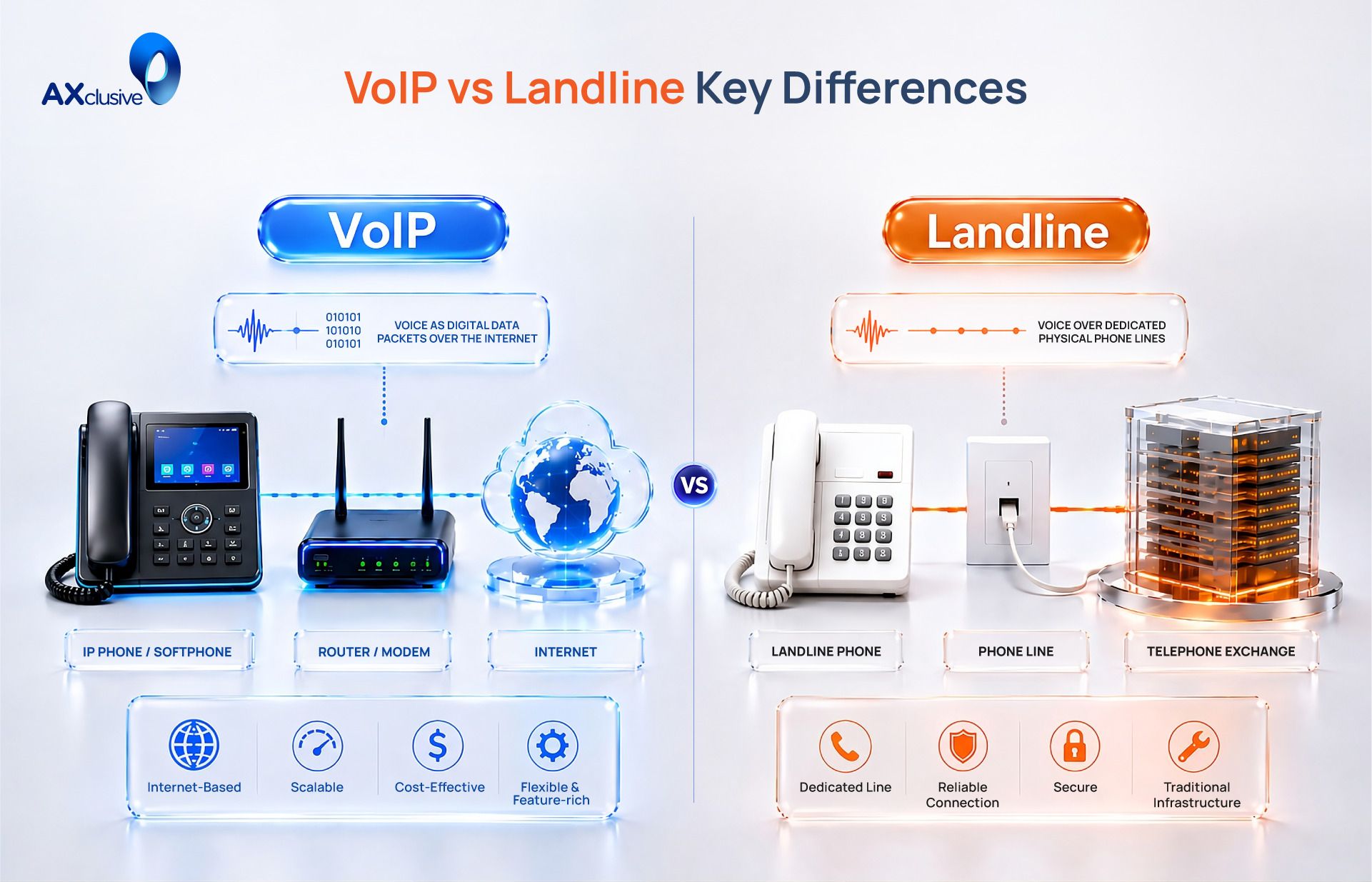
VoIP vs landline key differences
Feature | VoIP (Cloud Phone) | Landline (Traditional) |
Technology | Digital packets via Internet | Analog signals via Copper |
Setup Cost | Low; no server needed | High; requires on site PBX |
Monthly Fee | $10 to $15 per user | $50 or more per line |
Scalability | Instant via web portal | Slow; requires new wiring |
Mobility | Remote and mobile friendly | Fixed to office location |
Features | Video, AI, and Analytics | Basic Voice and Voicemail |
Redundancy | Automatic mobile failover | Limited to physical lines |
Maintenance | Managed by provider | Requires on site IT support |
VoIP vs landline key factors to consider
Selecting a business communication system requires a careful evaluation of technical requirements and long-term operational goals. You must look beyond the initial setup and consider how each system affects your daily workflow. The choice between VoIP vs landline depends on your current infrastructure and your plans for growth. This section breaks down five critical factors to help you identify the most resilient solution for your needs.
Cost efficiency
Legacy phone systems involve heavy upfront capital investment. You must purchase physical hardware, including PBX server boxes, proprietary desk phones, and extensive copper wiring. Installation requires paid visits from specialized technicians. Furthermore, traditional carriers often charge high monthly fees per line and premium rates for international calls.
VoIP operates on an Operational Expenditure (OpEx) model. You avoid massive upfront costs by utilizing your existing internet connection. Most providers allow a "Bring Your Own Device" (BYOD) approach, where employees use laptops, smartphones, or existing IP phones. Pricing is subscription-based, usually charged per user. This model includes maintenance and security updates in the monthly fee. Businesses typically see a 40% to 60% reduction in communication costs after switching to the cloud.
Ease of use
Setting up a traditional landline is a slow, manual process. You must wait for a service provider to run physical lines to your building and configure the onsite hardware. Managing the system often requires technical knowledge of old-fashioned telephone exchange logic. Simple tasks like changing an extension or adding a new user require physical adjustments.
VoIP platforms prioritize user experience through web-based dashboards. You can activate a new phone number or add an employee in seconds via an administrative portal. The interface resembles modern software applications, making it intuitive for non-technical staff. Users can switch between desk phones and mobile apps seamlessly. This flexibility ensures that your communication remains consistent even when employees move between the office and home.
Maintenance needs
Analog systems require physical onsite repairs when a fault occurs. If a wire breaks or a hardware card fails, your phone system remains down until a technician arrives. This creates a significant maintenance burden for your internal IT team. You are also responsible for managing power backups and climate control for your server room to protect the equipment.
VoIP shifts the maintenance responsibility to the service provider. The vendor manages all backend infrastructure, security patches, and hardware upgrades in their secure data centers. Your only responsibility is maintaining a stable internet connection and keeping your router firmware updated. If a problem arises, the provider resolves it remotely. This allows your team to focus on core business tasks instead of troubleshooting phone lines.
Reliability level
Standard landlines offer independent power and high stability. Copper lines carry their own low-voltage electricity, which allows analog phones to work during building power outages. They are immune to internet fluctuations and provide consistent audio quality. However, they are vulnerable to physical damage from bad weather or construction accidents that sever the cables.
VoIP reliability depends entirely on your internet connection. Most professional providers guarantee 99.9% uptime through Service Level Agreements (SLAs). If your internet goes down, your desk phones will stop working. To ensure maximum reliability, you should use a high-quality router with Quality of Service (QoS) settings and an Uninterruptible Power Supply (UPS). Many VoIP systems include automatic failover, routing calls to mobile devices if the primary office connection fails.
Scalability potential
Physical wiring limits how fast you can grow with a landline system. Each new employee needs a dedicated physical port and a wire run to their desk. If you exceed the capacity of your PBX box, you must purchase expensive expansion modules or a new server. This makes scaling a slow and costly endeavor, especially for businesses with multiple locations.
VoIP offers near-infinite scalability. You can add one user or one hundred users instantly without installing a single new wire. The system treats every device as a digital endpoint regardless of its physical location. This makes it the ideal choice for companies that plan to expand globally or support a hybrid workforce. You simply adjust your subscription tier to match your current headcount, ensuring you never pay for capacity you do not use.
VoIP vs landline benefits of switching to VoIP
The telecommunications landscape has shifted definitively toward the internet. While traditional copper wire systems remain functional, they lack the agility required for modern business operations. Evaluating VoIP vs landline reveals that cloud-based telephony offers a distinct competitive advantage. Transitioning to Voice over IP (VoIP) transforms a static utility into a dynamic, feature-rich tool that directly supports business growth and operational efficiency.
Lower costs
The most immediate benefit of replacing a landline with VoIP is financial. Traditional phone service requires a physical connection at every desk, leading to high installation costs, expensive hardware maintenance, and steep monthly line rentals. VoIP utilizes your existing internet connection, eliminating these heavy capital expenditures. Furthermore, domestic and international calling rates on VoIP networks are significantly lower than traditional carrier tariffs, making it highly cost-effective for businesses with large call volumes or multiple office locations.
Work from anywhere
Landlines physically chain employees to their desks. VoIP severs this tie, enabling true workforce mobility. With a cloud-based system, your business phone number is not attached to a physical wire; it is linked to a user account. Employees can make and receive professional calls using a physical IP phone in the office, a desktop application on their laptop, or a softphone app on their personal smartphone, regardless of their geographic location.
Easy to scale
Business growth creates friction for traditional phone systems. Adding new employees requires scheduling a technician to install new physical wiring and purchasing expensive expansion modules for the onsite PBX. VoIP scales instantly. System administrators can provision new phone lines, assign extensions, and deploy numbers in minutes through a web-based dashboard. If your workforce shrinks, you can remove lines just as easily, ensuring you never pay for unused capacity.
Software integration
A traditional landline is an isolated piece of hardware. A VoIP system is a software application that integrates natively with your existing digital tools. You can connect your phone system directly to your Customer Relationship Management (CRM) software, such as Salesforce or HubSpot. This integration enables features like automated call logging, screen pops with customer information before you answer, and click-to-dial functionality, saving time and significantly boosting team efficiency.
Better call quality
Historically, Plain Old Telephone Service (POTS) suffered from static and line noise as copper wires degraded over time. Modern VoIP technology utilizes wideband audio codecs (often branded as "HD Voice") to deliver sound clarity that surpasses traditional analog lines. Provided your business maintains a fast and stable internet connection with properly configured Quality of Service (QoS) rules on your router, VoIP guarantees crisp, interference-free conversations.
Simple to use
Despite the advanced technology powering it, VoIP is designed for user-friendly deployment. Setting up a new employee often requires nothing more than plugging an IP phone into an Ethernet port or downloading an app. The intuitive, web-based management portals allow non-technical office managers to handle complex tasks like setting up call routing, managing ring groups, and changing voicemail greetings without needing to hire a specialized telecom technician.
Higher reliability
While dependent on internet connectivity, modern VoIP architecture offers superior redundancy compared to physical landlines. A severe storm or a construction accident can sever a copper phone line, taking an entire branch offline until physical repairs are made. VoIP systems reside in secure, redundant cloud data centers. If your local office loses power or internet, the VoIP system automatically reroutes incoming calls to employee mobile phones or an alternative branch, ensuring your business remains accessible.
Advanced features
Traditional landlines provide dial tone, caller ID, and basic voicemail. VoIP platforms deliver a complete Unified Communications (UC) suite. Standard VoIP subscriptions typically include advanced capabilities that would cost thousands of dollars to add to a legacy PBX. These features include auto-attendants (virtual receptionists), voicemail-to-email transcription, call recording, video conferencing, and detailed call analytics, empowering your team to operate more professionally and productively.
VoIP vs. Landline FAQs
Is VoIP better than landlines?
Yes, for the vast majority of modern businesses, VoIP is significantly better. It offers lower operational costs, seamless scalability, and advanced features like video conferencing, mobile app integration, and voicemail-to-email that traditional analog landlines simply cannot support without expensive, specialized hardware.
How reliable is a VoIP system compared to traditional phones?
VoIP is highly reliable, but it depends entirely on your internet connection. While traditional landlines have their own power source and work during local power outages, a VoIP system will go down if your internet or power fails. However, VoIP offers superior redundancy; if your office loses connectivity, calls can automatically reroute to employee mobile phones or a backup location instantly.
What makes VoIP more cost effective?
VoIP is more cost-effective because it uses your existing internet connection to transmit calls, eliminating the need to pay a telephone company for dedicated copper lines and expensive on-premise PBX servers. Furthermore, VoIP providers typically include domestic calling and advanced features in a flat monthly, per-user subscription rate, whereas landline providers charge extra for every feature and long-distance minute.
Can I replace my landline with VoIP?
Absolutely. You can completely replace your traditional landline with a VoIP system. The process, known as "porting," allows you to transfer your existing business phone numbers directly to your new VoIP provider. This ensures a seamless transition without disrupting your customers or having to update your marketing materials.
The choice between VoIP vs landline systems defines the future of your business communication. While traditional landlines provide physical reliability, VoIP offers the flexibility, advanced features, and cost savings required to stay competitive in a modern, mobile-first economy. This guide from Axclusive delivers the clarity needed to evaluate your infrastructure and select the system that best supports your operational goals. By embracing cloud-based telephony, you can build a more agile, scalable, and professional communication network.
VoIP and landline phone systems offer different advantages for business communication. Contact us to find the right voice solution with Axclusive ISP.