
SD WAN vs MPLS Which Network Is Right for Your Business
Building a fast and secure corporate network requires choosing the right technological foundation. The core difference in the SD WAN vs MPLS comparison is that one relies on expensive, dedicated physical hardware, while the other utilizes flexible, internet based software routing. Join Axclusive ISP in the article below to quickly learn exactly how these technologies differ and which one your business should adopt.
SD WAN vs MPLS Business Benefits and Challenges
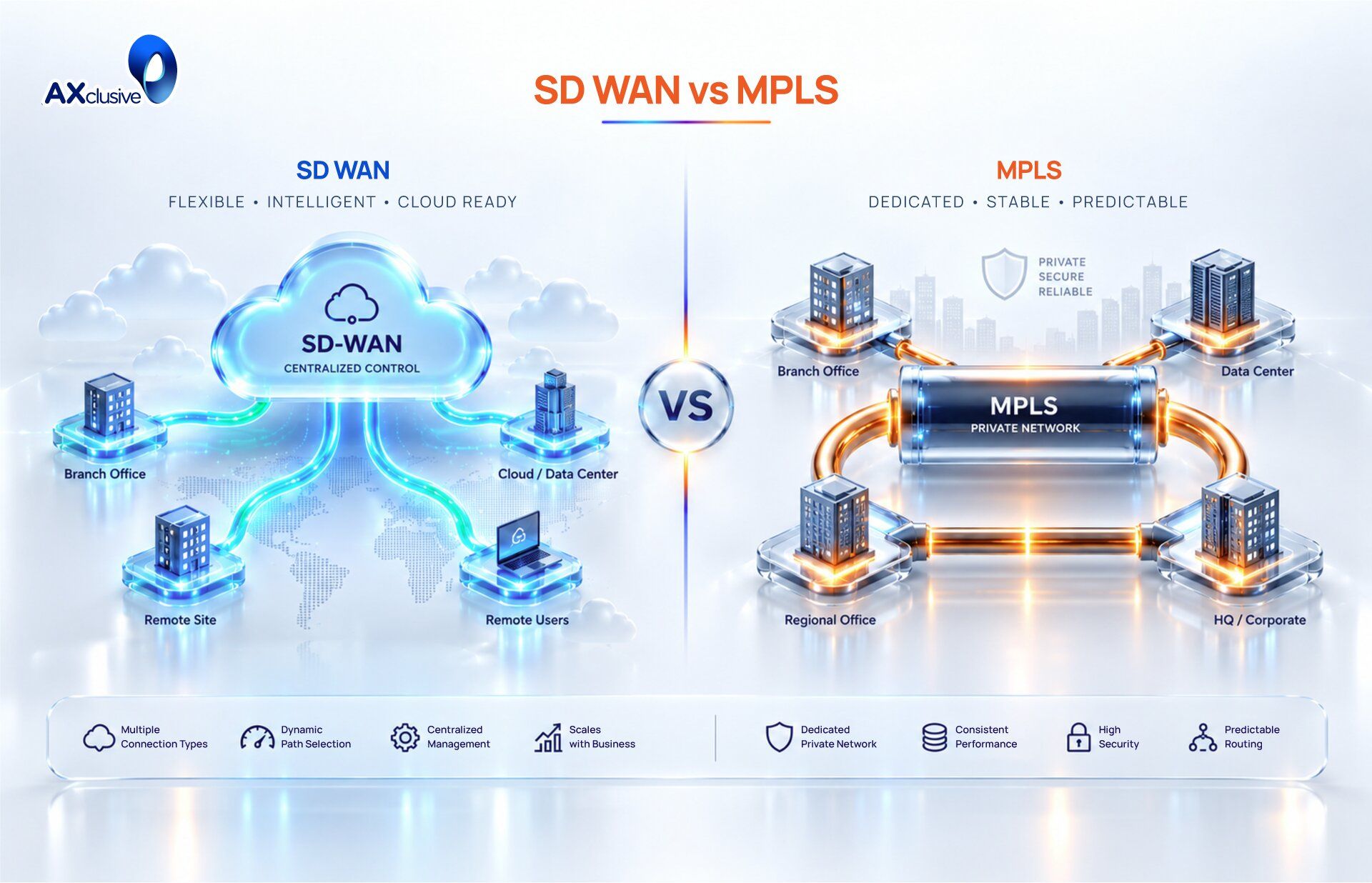
To make the best infrastructure decision for your enterprise, IT leaders must carefully analyze the specific strengths and limitations of both networking solutions. While one offers unmatched stability through physical hardware, the other provides the extreme flexibility required for modern cloud computing.
Below is a detailed breakdown of the business benefits and operational challenges associated with both technologies:
| Business Metric | Multiprotocol Label Switching (MPLS) | Software Defined WAN (SD WAN) |
| Infrastructure and Setup | Operates as a physical underlay network relying on dedicated private circuits. Deployment is highly complex and demands specialized engineering expertise. | Functions as a virtual overlay network that can combine any type of internet connection. It is incredibly easy to deploy and configure centrally. |
| Scalability and Costs | Expanding the network is very slow and highly expensive because it requires installing new dedicated physical lines at every branch. | Extremely scalable and highly cost effective. Businesses can add new locations instantly using standard broadband connections. |
| Traffic Optimization | Traffic routing is static and heavily centralized. However, it delivers incredibly consistent performance backed by strict guaranteed service level agreements. | Features dynamic, application aware routing. It ensures high network uptime by automatically steering traffic to the best available path during outages. |
| Security Capabilities | Offers basic private routing but requires expensive, external bolt on tools to achieve true data encryption and security. | Comes with robust built in encryption, comprehensive threat visibility, and native cloud security protocols. |
| Network Troubleshooting | Issue resolution is often very slow because administrators are entirely carrier dependent to fix hardware problems. | Provides fast, centralized troubleshooting through a single cloud dashboard, giving IT teams full visibility. |
| Future Business Outlook | Remains highly stable and reliable, but is slowly losing relevance as companies move away from centralized data centers. | Rapidly dominating the market due to the massive global demand for cloud driven and remote work environments |
Advantages of SD WAN vs MPLS
When evaluating performance and operational efficiency, both technologies offer distinct competitive advantages depending on your network architecture:
- Traffic Management: MPLS excels at creating fixed, highly reliable physical paths to maximize resource use. SD WAN offers superior flexibility by dynamically steering traffic based on real time application needs.
- Quality of Service: MPLS uses strict data labels to guarantee priority for critical traffic. SD WAN utilizes dynamic policies to ensure smooth, uninterrupted performance for real time video and voice applications.
- Scalability: Expanding an MPLS network is slow and expensive because it requires installing new physical circuits. SD WAN scales effortlessly by combining multiple broadband links to add capacity on demand.
- Security Integration: MPLS isolates your data from the public web but lacks native encryption. SD WAN brings security directly to the edge, featuring built in encryption, firewalls, and advanced cloud protection.
- Cloud Agility: SD WAN is built specifically to integrate seamlessly with modern cloud platforms. Conversely, forcing MPLS to connect to cloud services requires complex and inefficient routing workarounds.
Limitations of SD WAN and MPLS
Despite their strengths, neither solution is perfect. IT leaders must account for the following technical and financial hurdles:
- Cost Barriers: MPLS carries massive recurring expenses due to high provider fees and dedicated circuit costs. While SD WAN significantly lowers monthly transit bills, it does require a notable upfront investment in edge hardware and software licenses.
- Management Complexity: MPLS deployment requires highly specialized telecom engineers and is notoriously slow to set up. SD WAN drastically simplifies daily centralized management, but configuring the initial cloud integrations still demands strong IT expertise.
- Bandwidth Constraints: MPLS bandwidth is rigidly fixed, meaning upgrades take months to implement. SD WAN is highly flexible, but its actual performance remains at the mercy of your local internet service providers.
- Vulnerability to Outages: MPLS networks rely entirely on a single carrier infrastructure, meaning one major failure can take down multiple sites. SD WAN mitigates this risk using automatic failover, though severe local broadband drops can still cause temporary performance issues.
SD WAN vs MPLS Business Use Cases
Choosing the right networking technology heavily depends on your daily operational needs. Each solution shines in very specific enterprise environments. Below are the most common scenarios driving the adoption of both technologies.
SD WAN use cases
This modern, software driven approach is ideal for dynamic businesses that prioritize flexibility, cost efficiency, and heavy cloud computing. The best use cases include:
- Direct Cloud and Branch Connectivity: Perfect for remote branches that need to connect directly to the cloud without routing data back to a central hub. This eliminates bottlenecks and massively boosts application speed.
- Cost Optimization Strategies: Ideal for enterprises looking to lower connectivity costs. Organizations can replace expensive private lines with multiple, highly affordable internet links like broadband or 5G.
- Centralized Network Management: Suited for IT teams managing dozens of global locations. Administrators can control the entire network and push security policies to every branch instantly from one central dashboard.
- Advanced Branch Security: Highly effective for companies needing built in protection at the network edge. It natively includes application firewalls, intrusion prevention, and URL filtering.
- Deep Operational Visibility: Provides administrators with a real time, birds eye view of all network traffic, making it incredibly easy to prioritize critical applications and troubleshoot issues quickly.
MPLS use cases
Despite the rise of cloud computing, this traditional physical infrastructure remains highly relevant for organizations that demand strict data isolation and guaranteed uptime. The best use cases include:
- Building a Private Corporate Network: This is the absolute standard for establishing a highly reliable, physically dedicated connection between multiple remote corporate branches and a central data center.
- Strict Traffic Prioritization: Essential for businesses running highly sensitive, real time applications (like hospital databases or financial trading platforms) that require ironclad Service Level Agreements for guaranteed uptime.
- Private Data Security: Ideal for organizations handling highly confidential data. Because the network runs on dedicated private links isolated from the public internet, it provides a naturally secure environment, even without heavy encryption.
SD WAN vs MPLS Key Factors to Consider
Selecting the right network infrastructure is a major strategic decision that will impact your business operations for years. To choose the most suitable technology, IT leaders must carefully evaluate these seven critical factors:
- Core Business Requirements: Start by defining your exact organizational goals. You must consider the total number of remote branch locations, the sensitivity of your corporate data, and whether your daily operations rely heavily on cloud applications or traditional data centers.
- Performance and Availability: SD WAN excels at prioritizing applications and balancing traffic loads across multiple connection types simultaneously. Conversely, MPLS provides a rigid, fixed bandwidth that cannot actively balance loads but guarantees incredibly low latency for critical real time applications.
- Network Traffic Patterns: Analyze how data moves across your company. If your workforce heavily utilizes cloud based services and requires massive bandwidth, a software defined approach is vastly superior.
- Budget and Long Term ROI: MPLS requires a massive upfront financial investment due to the installation of dedicated physical circuits. SD WAN offers significant cost savings over time by utilizing affordable broadband options, making it the better choice for tight enterprise budgets.
- Security and Compliance Rules: If your industry requires strict regulatory compliance, you must assess how data is protected. MPLS isolates traffic naturally but requires data to be sent back to a central hub for security checks. SD WAN natively integrates advanced encryption, traffic segmentation, and edge security features directly into the network.
- Future Growth and Scalability: If your company anticipates rapid expansion or needs to open new offices quickly, SD WAN provides the necessary agility and automation. MPLS is only recommended for businesses with highly predictable, stable, and slow growth.
- Deployment Complexity: Setting up an MPLS network is a lengthy, labor intensive process that requires heavy coordination with telecom providers and specialized engineers. SD WAN drastically simplifies rollouts through centralized templates, allowing businesses to get new branches online much faster.
Navigating a major network overhaul can certainly feel overwhelming for any technical team. However, resolving the SD WAN vs MPLS dilemma simply means finding the best match for how your employees actually work. Whether you decide to stick with the rock solid privacy of dedicated physical circuits or embrace the incredible freedom of software defined routing, you do not have to make this transition alone. Axclusive ISP is always right here to support your journey and keep your global business perfectly connected.
SD WAN vs MPLS offers different approaches to network performance, cost, and scalability. Contact us to choose the right enterprise connectivity solution with Axclusive ISP.