

How to Prevent DDoS Attacks? Tools and Prevention Strategies
DDoS attacks can paralyze your digital infrastructure in seconds. To maintain uptime, you must transition from reactive patching to a proactive defense strategy. Join Axclusive as we explore essential best practices to fortify your network and ensure your services remain available against modern cyber threats.
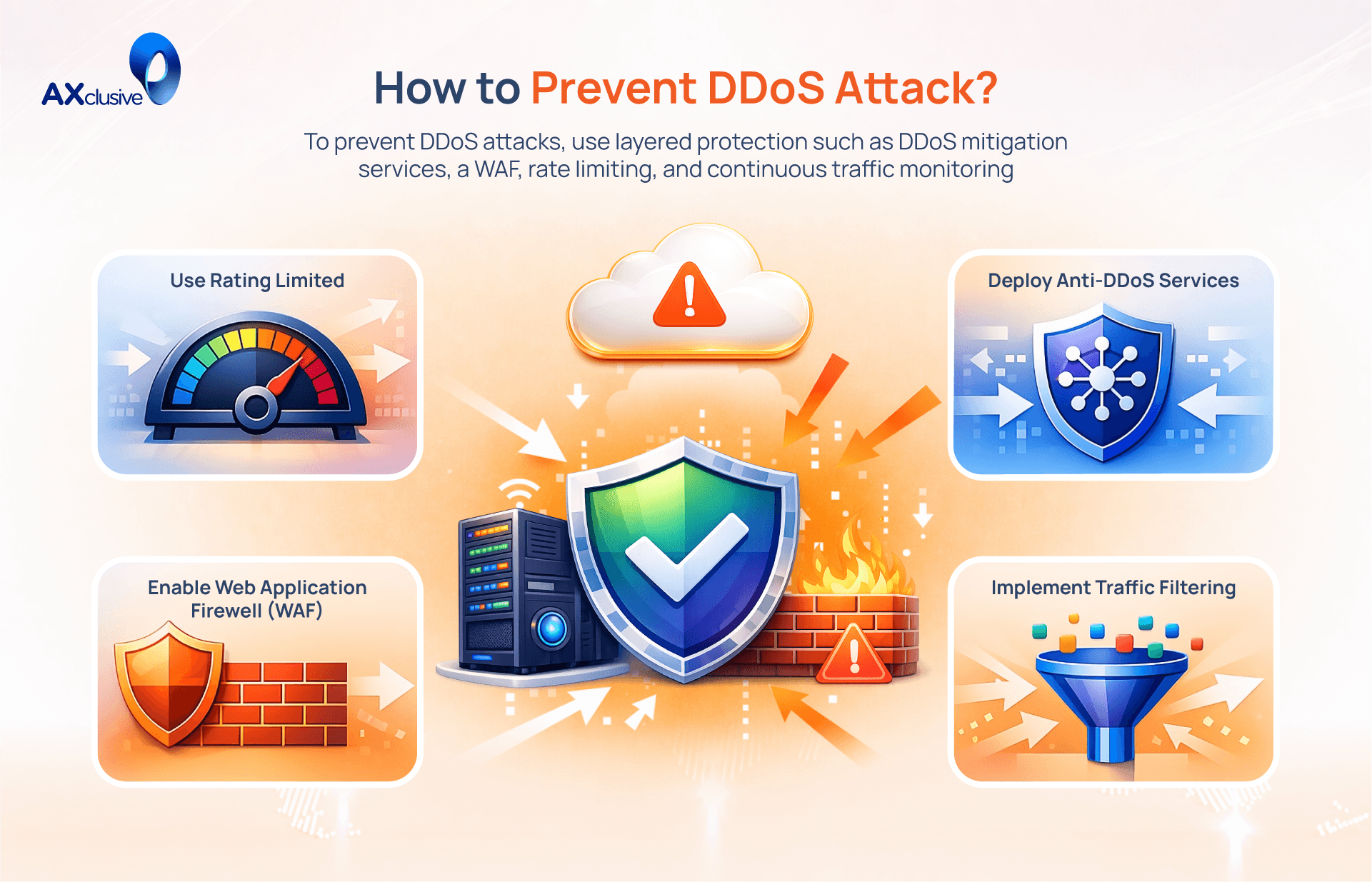
Effective Ways to Prevent DDoS Attacks
While no single measure can completely prevent every DDoS attack, organizations can reduce their exposure and make networks more resilient by combining several DDoS prevention methods.
- Reduce the Attack Surface: Limiting unnecessary network exposure reduces the number of potential entry points attackers can target. Organizations can disable unused ports and protocols, restrict access where appropriate, and use firewalls or load balancers to control how traffic reaches critical systems.
- Distribute Traffic with Anycast: Anycast routing distributes incoming traffic across multiple network locations instead of relying on a single destination. This helps spread sudden traffic surges across available infrastructure and reduces the risk of one server or location becoming overwhelmed.
- Monitor Network Traffic Continuously: Real-time traffic monitoring helps identify unusual increases in requests, abnormal connection patterns, or suspicious sources. Early detection allows security teams and automated protection systems to respond before malicious traffic significantly affects service availability.
- Use CDN and Content Caching: A Content Delivery Network (CDN) can cache frequently requested content closer to users, reducing the number of requests that must reach the origin server. This decreases origin infrastructure load and provides additional capacity to handle sudden traffic spikes.
- Apply Rate Limiting: Rate limiting controls how many requests a user, IP address, or endpoint can make within a defined period. Properly configured limits can reduce excessive requests and help protect applications and servers from certain request-based DDoS attacks.
Discover how Cloudflare Magic Transit DDoS Protection helps protect network infrastructure by detecting and filtering malicious traffic before it can disrupt critical services.
Key Tools to Prevent DDoS Attacks
Organizations can combine multiple DDoS prevention tools to detect suspicious activity, control excessive traffic, and improve network resilience against different types of attacks.
- Intrusion Detection and Prevention Systems (IDPS): IDPS monitors network activity for suspicious behavior and known threat patterns. When potentially malicious traffic is detected, the system can generate alerts or automatically block the activity based on configured security policies.
- Web Application Firewall (WAF): A WAF analyzes HTTP and HTTPS traffic before requests reach a web application. It can filter suspicious requests and apply security rules to help protect applications against Layer 7 DDoS attacks.
- Load Balancers: Load balancers distribute incoming requests across multiple servers or resources. This prevents traffic from being concentrated on a single server and helps maintain application availability during sudden increases in demand.
- Rate Limiting Tools: Rate limiting controls the number of requests that a user, IP address, or endpoint can send within a specific period. This can reduce excessive request activity and protect application resources from certain request-based attacks.
- Content Delivery Networks (CDNs): CDNs distribute and cache content across geographically dispersed servers. By serving requests closer to users and reducing direct traffic to the origin server, a CDN can provide additional capacity during large traffic spikes.
- Cloud-Based DDoS Protection: Cloud-based DDoS protection services analyze and filter traffic through scalable mitigation infrastructure before malicious traffic reaches the protected network. This approach is particularly useful for handling high-volume attacks that may exceed the capacity of local infrastructure.
The Importance of DDoS Attack Prevention for Businesses
Effective DDoS prevention helps organizations maintain service availability, protect business operations, and reduce the wider impact of unexpected network disruptions. Without adequate protection, a successful attack can affect revenue, customer experience, and internal resources.
- Financial Losses: When websites, applications, or online services become unavailable during a DDoS attack, businesses may lose transactions and revenue. Organizations may also face additional costs related to incident response, infrastructure recovery, mitigation services, and service-level commitments.
- Reputation and Customer Trust: Reliable access to digital services is important for customers and business partners. Frequent or extended outages can create a poor user experience and reduce confidence in an organization’s ability to provide dependable services.
- Operational Disruption: DDoS attacks can consume network resources and require significant attention from IT and security teams. Responding to an attack may divert resources from normal operations, infrastructure maintenance, customer support, and other important business activities.
Frequently Asked Questions
Can DDoS attacks be prevented?
While you cannot prevent an attacker from attempting a DDoS attack, you can effectively neutralize one before it impacts your services. By maintaining robust network resilience, implementing proactive traffic monitoring, and deploying cloud-based mitigation tools, organizations can absorb and filter malicious traffic, ensuring legitimate users remain unaffected.
What is the solution for a DDoS attack?
The primary solution is to utilize an "always-on" DDoS mitigation service, such as a cloud-based scrubbing platform. These services automatically detect anomalous traffic spikes and reroute incoming requests through a high-capacity filter that discards malicious packets while allowing genuine user traffic to pass through to your origin server.
Can Attackers Combine Multiple DDoS Methods?
Yes. Sophisticated attackers frequently use "multi-vector" attacks. They might combine a volumetric flood (targeting network bandwidth) with an application-layer attack (targeting server resources like HTTP requests). This strategy is designed to overwhelm security teams by attacking multiple layers of the protocol stack simultaneously.
Can a Firewall Block a DDoS Attack?
A traditional firewall is often insufficient against large-scale DDoS attacks. While firewalls can block basic, unauthorized access, they are not designed to handle the massive traffic volume of a volumetric DDoS flood. The firewall itself often becomes the bottleneck, crashing under the sheer request count. Effective defense requires dedicated DDoS mitigation tools, such as Web Application Firewalls (WAF) or cloud-based edge filtering.
Proactive defense is the cornerstone of a resilient digital infrastructure. By establishing traffic baselines, prioritizing critical assets, and deploying automated mitigation services, you can successfully neutralize even the most sophisticated cyber threats. Axclusive trusts this guide has provided the foundational knowledge you need to learn how to prevent DDoS attacks and ensure continuous uptime for your business.
Discover how to prevent DDoS attack and keep your network resilient against evolving cyber threats. Click here or Contact us now to strengthen your protection and stay ahead of attack.