
CWDM vs DWDM Which Optical Network Solution Is Better
Expanding fiber capacity requires choosing between CWDM vs DWDM. This decision dictates your network reach and project cost. Join Axclusive below to compare these optical standards and identify the right solution for your infrastructure.
CWDM vs DWDM key differences
When evaluating optical networking solutions, the choice between CWDM vs DWDM is a critical decision that impacts cost, capacity, and network reach. Both Coarse Wavelength Division Multiplexing (CWDM) and Dense Wavelength Division Multiplexing (DWDM) serve the same purpose: they multiply the capacity of a single fiber optic cable. However, they achieve this goal through different technical methods, each suited for specific network environments. Understanding these key differences is essential for designing a cost-effective and scalable optical infrastructure.
Channel spacing comparison
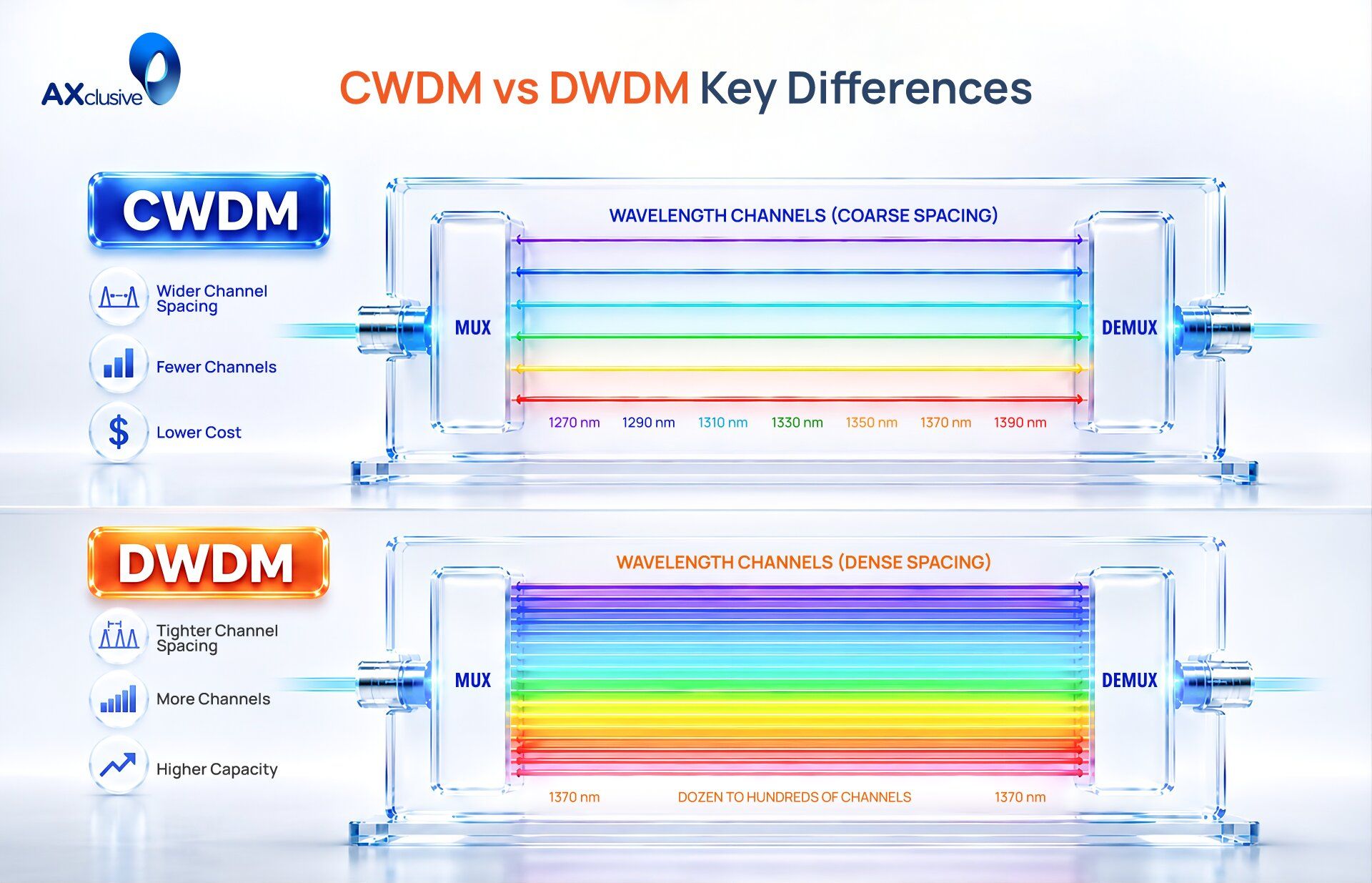
Channel spacing defines the frequency gap between two adjacent light signals on a fiber. This spacing dictates how many independent data streams a single cable can carry. CWDM utilizes a wide channel spacing. The standard gap between CWDM wavelengths is 20 nanometers (nm). This spectrum grid operates from 1271nm to 1611nm. Because of this wide gap, a standard CWDM system supports a maximum of 18 distinct channels. The wide spacing means the optical filters do not need extreme precision.
DWDM utilizes extremely narrow channel spacing. Engineers measure DWDM gaps in gigahertz (GHz) rather than nanometers. Standard DWDM systems use a 100 GHz (0.8nm) or 50 GHz (0.4nm) grid. They operate primarily within the C-band (1525nm to 1565nm) and L-band (1570nm to 1610nm). This tight packing allows DWDM to carry 40, 80, or up to 160 separate channels on one fiber. The narrow gaps require high-quality optical components to prevent signal overlap. You must use DWDM if your network demands dozens of dedicated connections over a single fiber run.
Transmission range capability
Optical signals degrade as they travel through glass fiber. The maximum transmission range depends heavily on the multiplexing technology. CWDM systems face strict distance limitations. A standard CWDM signal can reach a maximum distance of approximately 160 kilometers. You cannot amplify CWDM signals effectively across its wide spectrum. Once the light degrades beyond a certain point, the data drops. This makes CWDM strictly a short-range, metro-area solution.
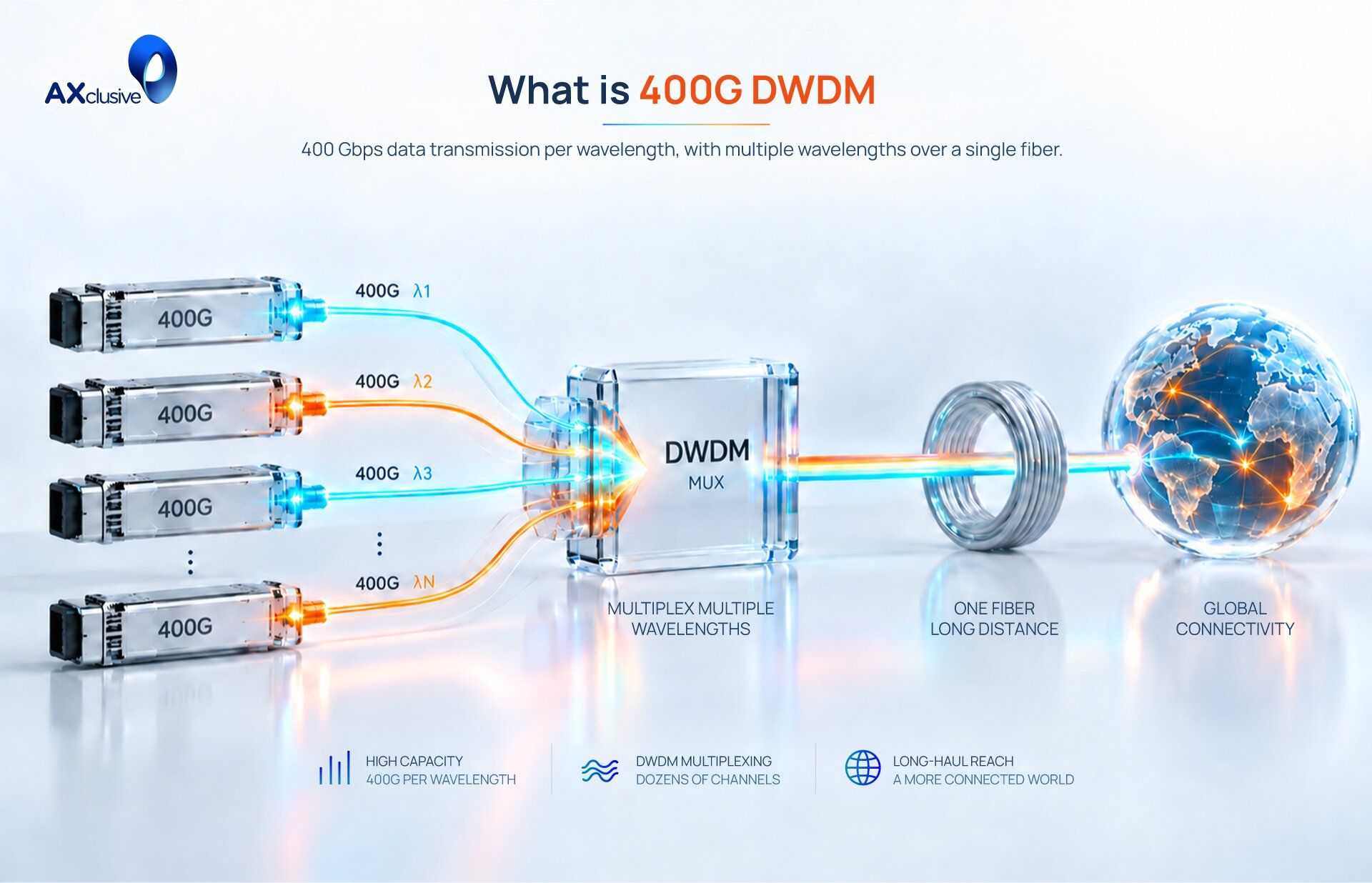
DWDM excels in long-distance data transmission. The narrow wavelengths used in DWDM integrate highly with the fiber core during transit. More importantly, DWDM operates within the spectrum band where Erbium-Doped Fiber Amplifiers (EDFAs) function. Network engineers install these optical amplifiers at intervals along the fiber path. The amplifiers boost the light signal without converting it back into electricity. This allows DWDM systems to push data across thousands of kilometers. Telecommunication carriers use amplified DWDM to build transcontinental internet backbones.
Laser modulation approach
Transceivers use lasers to generate light pulses. The modulation approach differs significantly between the two standards. CWDM systems utilize uncooled lasers. These lasers rely on electronic tuning. Because CWDM channel spacing is wide, the system tolerates normal temperature shifts. The laser frequency can drift slightly without crossing into an adjacent channel. Uncooled lasers consume very little electricity. They generate minimal heat in your server racks.
DWDM systems require cooled lasers. The narrow channel spacing demands absolute precision. If a DWDM laser drifts even a fraction of a nanometer, it will interfere with the neighboring channel and corrupt the data. To prevent this, DWDM transceivers incorporate temperature tuning components. These coolers keep the laser at a precise, constant temperature regardless of the room conditions. This cooling mechanism ensures better performance, higher safety, and a longer lifespan for the optical hardware. However, it draws significantly more power.
Bandwidth capacity
Total bandwidth capacity determines how much data your network can handle simultaneously. CWDM handles lower capacity loads. Standard pluggable CWDM transceivers max out at 100 Gbps per channel. When you combine all available channels, a typical CWDM installation manages a total throughput of around 400 Gbps. This capacity suits most standard enterprise campus networks and regional ISP links.
DWDM provides massive bandwidth capabilities. The technology easily supports 100G, 400G, and 800G per channel. With modern coherent optics, integrated DWDM components can push over 1 Terabit per second (Tbps) on a single wavelength. When multiplied by 80 or 96 channels, a single fiber pair can transport tens of terabits of data. Cloud service providers and massive data centers require this extreme capacity. You can upgrade individual channels to higher speeds without replacing the underlying multiplexing hardware.
Typical use cases
Network location and business goals dictate the use case for each technology. CWDM fits perfectly in metropolitan access networks and enterprise campuses. Cable TV providers use CWDM optics, like GBIC and SFP modules, for efficient local data and voice transmission. Passive CWDM solutions require no electricity, making them ideal for Fiber to the Premises (FTTP) deployments. It provides a highly effective way to link office buildings within the same city.
DWDM dominates the core telecommunications sector. Major carriers use it for secure, long-distance backbones. It forms the foundation of modern core and metro transport networks. Furthermore, high-throughput data centers rely on DWDM for Data Center Interconnect (DCI). Large technology companies use DWDM to synchronize active workloads across geo-distributed architectures. If a financial institution needs to mirror trading data instantly to a backup site 500 miles away, they deploy a DWDM link.
Cost comparison
Budget constraints heavily influence infrastructure decisions. CWDM provides the lowest entry cost. The uncooled lasers and wider filters are much cheaper to manufacture. You can deploy a basic passive CWDM link for a fraction of the cost of a dense system. However, DWDM system components, such as multiplexers and optical amplifiers, remain four to five times more expensive than CWDM equipment. The complex temperature tuning required for cooled lasers drives up these manufacturing costs.
Despite the high system cost, individual DWDM transceivers have seen a massive price drop. Due to global popularization and high manufacturing volumes, a standard DWDM transceiver often costs 20% to 25% less than its CWDM equivalent today. When evaluating costs, you must calculate the total cost of ownership. CWDM wins for short, low-capacity links. DWDM wins for long-distance, high-capacity links where leasing multiple physical fibers would break the budget.
CWDM vs DWDM pros and cons comparison
Selecting the right optical networking technology requires a careful evaluation of the trade-offs between cost and performance. The primary difference between CWDM and DWDM channel spacing directly influences every aspect of the system, from hardware expense to transmission distance.
Strengths and limitations of CWDM
CWDM is a simpler technology, utilizing wider channel spacing that allows for less precise, lower-cost components. This makes it an ideal solution for metro and regional networks where initial deployment cost is a primary consideration. However, this simplicity comes at the cost of lower capacity and shorter transmission distances.
| CWDM Advantages | CWDM Limitations |
| Lower Initial Cost: Simpler, uncooled lasers and wider filters reduce upfront hardware expenses. | Limited Channel Capacity: Supports a maximum of 18 channels, restricting future scalability. |
| Lower Power Consumption: Uncooled components use significantly less electricity. | Shorter Transmission Distance: Signal cannot be optically amplified, limiting reach to approximately 160 km. |
| Smaller Physical Footprint: Passive components require less rack space. | No Optical Amplification: Signal must be regenerated (O-E-O conversion), which adds latency. |
| Flexible Fiber Support: Can operate over both standard Single-Mode Fiber (SMF) and older fiber types. | Not Carrier-Grade: Lacks the sophisticated management features of DWDM systems. |
DWDM Advantages and Disadvantages
DWDM is the high-performance standard for core networks, designed for maximum capacity and distance. By using precision lasers and narrow channel spacing, it can transmit terabits of data over a single fiber. While it offers unparalleled performance, the technology requires a higher initial investment and more complex management.
| DWDM Advantages | DWDM Disadvantages |
| Massive Bandwidth Capacity: Supports 80, 96, or more channels for multi-terabit throughput. | Higher Initial Cost: Requires expensive, temperature-controlled lasers and precision filters. |
| Ultra-Long-Haul Reach: Signal can be optically amplified, enabling transmission over thousands of kilometers. | Higher Power Consumption: Cooled lasers and amplifiers consume more electricity. |
| "Pay-as-you-grow" Scalability: Add new wavelengths incrementally without disrupting existing traffic. | Requires More Rack Space: Amplifiers and other active components increase the physical footprint. |
| Carrier-Grade Management: Mature OAM (Operations, Administration, and Maintenance) systems provide robust network control. | Requires High-Quality Fiber: Performs optimally only on modern, low-loss single-mode fiber. |
FAQs
Which option is more suitable, CWDM or DWDM?
The choice depends on your specific distance and capacity requirements. CWDM is more suitable for short-range applications, such as enterprise campus links or metropolitan networks under 80 kilometers. DWDM is the better choice for long-haul routes or data center interconnects that require massive, scalable bandwidth over hundreds or thousands of kilometers.
Can CWDM and DWDM operate within the same network?
Yes, these two technologies can coexist within the same optical infrastructure. Engineers often use a method called "DWDM over CWDM." This involves mapping DWDM wavelengths into the passband of a specific CWDM channel. This hybrid approach allows organizations to increase capacity on an existing CWDM link without replacing the entire system.
What is the channel capacity of CWDM vs DWDM?
CWDM has a limited channel capacity, typically supporting a maximum of 18 individual wavelengths on a single fiber. DWDM offers significantly higher density due to its narrow channel spacing. Standard DWDM systems support 40, 80, or 96 channels, while advanced high-capacity systems can reach over 160 wavelengths on a single fiber pair.
Is it less expensive to deploy CWDM or DWDM?
CWDM is less expensive to deploy for initial setups and short distances. It utilizes uncooled lasers and passive components that require no electrical power, which lowers both capital and operational costs. While DWDM has a higher upfront cost for precision hardware and amplification, it provides a lower cost per gigabit as traffic volume increases.
Choosing between CWDM and DWDM defines the scalability of your optical infrastructure. CWDM provides an efficient solution for short-range links, while DWDM delivers the massive capacity required for long-distance transit. This guide from Axclusive highlights the technical distinctions to help you optimize your existing fiber assets. Align your technology selection with your specific distance and bandwidth needs to build a high-performance network.
CWDM vs DWDM impacts bandwidth, transmission distance, and network scalability. Contact us to choose the right optical networking solution with Axclusive ISP.