
High Latency to China? Don't Blame the Great Firewall Just Yet
When you experience high latency or packet loss to China, what normally gets blamed first?
The Great Firewall.
Yes, the Great Firewall of China, or GFW, does exist. There is plenty of technical research showing mechanisms such as DNS poisoning and HTTP/HTTPS filtering. It is also not one giant firewall sitting somewhere in Beijing. Research into the GFW shows filtering infrastructure distributed around China's border networks. [1][2] What it blocks and exactly how all those mechanisms work is probably a topic for another day.
Today, let’s look at something else.
Why do you sometimes experience high latency and packet loss when your traffic is heading to China?
This won't cover every possible situation. China's Internet is huge and complicated but I hope it gives you a better understanding of what actually happens to your traffic before you simply conclude:
It's China. Must be the GFW.
Quite often, there is more to the story.
Quick answer: Is the Great Firewall to Blame?
Sometimes — but often not. The Great Firewall is one variable among several. Congestion inside China's domestic carrier networks, the limited number of international gateway cities, expensive premium connectivity, and ordinary BGP routing decisions frequently cause just as much latency and packet loss as GFW filtering does. Before blaming the GFW, it's worth checking which carrier you're hitting, which backbone your traffic is on, and what route it actually took to get there.
Why Internet Connectivity Into China Is So Expensive
When we talk about Internet connectivity into mainland China, there are three major operators that we deal with:
- China Telecom
- China Unicom
- China Mobile
Within the industry, people sometimes collectively refer to them as the "3C".
Each has its own network, customer base and international connectivity. But from a network engineer's point of view, the more interesting point is this:
One carrier doesn't mean one network.
The cost of connecting into these networks can also vary quite a bit depending on where you are buying the service.
In markets such as the US and Europe, China connectivity can be more reasonably priced. In Asia, however, the premium is usually much higher.
Hong Kong is often one of the most expensive places to buy China connectivity, despite being physically the closest major international market to mainland China.
In general, the further away you are from China, the price per Mbps tends to come down. But even then, China-optimized connectivity is still usually priced at a significant premium compared with regular Internet transit.
So being geographically closer to China does not necessarily mean the connectivity will be cheaper. In fact, quite often, it is the opposite.
Inside China, the Network Is Much More Complicated Than One ASN
Inside China, each operator has national backbones, provincial networks, metropolitan networks and multiple service layers.
China Unicom, for example, publicly says its AS4837 Internet backbone connects to more than 330 Metropolitan Area Networks within mainland China. [3]
So even though the destination ultimately belongs to the same carrier, and you may only see the same main ASN from the outside, the packet can still pass through quite a lot of regional infrastructure before reaching the final user. Those internal networks have their own congestion problems too.
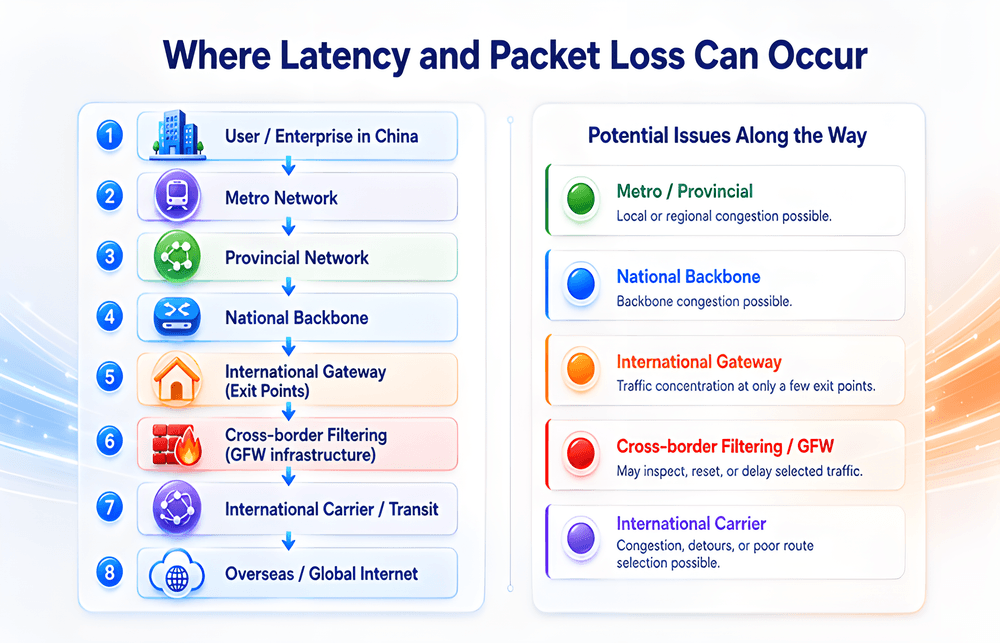
A simplified path might look something like:
User → Metro Network → Provincial Network → National Backbone → International Gateway → International Network
People tend to assume that if China connectivity is congested, the congestion must be on the submarine cable or the international link.
Not necessarily.
Traffic from many different cities and provinces has historically had to converge towards a relatively small number of locations where public international Internet traffic can enter and leave China.
So congestion can happen while your traffic is still travelling across the domestic carrier network.
- You could have congestion inside a metropolitan network.
- You could have congestion between the provincial network and the national backbone.
- Or perhaps the domestic network is perfectly fine, but the international interconnection is overloaded.
Then, around China's international network boundary, you also have the filtering infrastructure associated with the Great Firewall.
This is why I don't like the simple assumption:
Packet loss = Great Firewall.
There are simply too many other things happening along the same path.
China Telecom CN2, China Unicom AS9929 and China Mobile CMIN2 : One Carrier, Different Backbones
The next thing to understand is that the major Chinese operators don't just have one Internet network.
They operate different backbone networks and different service products. Some are designed for normal mass-market Internet traffic, while others are positioned for better international or enterprise performance.
A simplified view looks like this:
Carrier | Domestic Facing Core Network | International Facing Core Network | Premium (Next-gen) Network |
China Telecom | ChinaNet — AS4134 | ChinaNet — AS4134 | CN2 — AS4809 |
China Unicom | China169 — AS4837 | China169 — AS4837 | CU Premium - AS10099 |
China Mobile | CMNET — AS9808 | CMI - AS58453 | CMIN2 — AS58807 |
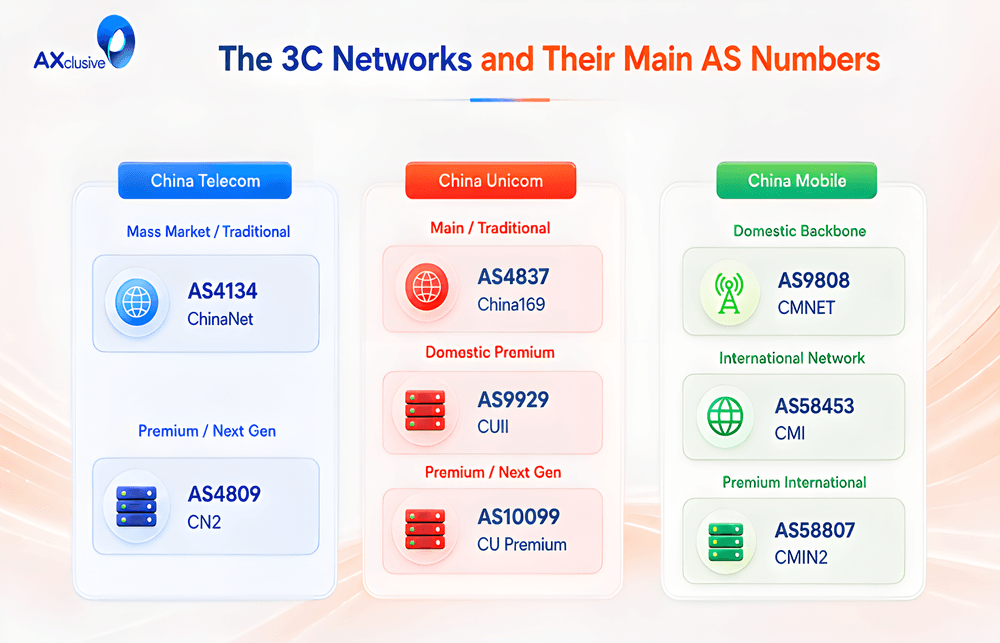
China Telecom and China Unicom's domestic networks connect directly to international carriers while China Mobile is structured slightly differently. Its domestic network, CMNET (AS9808), commonly hands international traffic to China Mobile International's network, CMI (AS58453), which then provides the international connectivity.
China Telecom describes CN2 AS4809 as its next-generation IP/MPLS carrier network and the successor to ChinaNet. [4]
China Unicom identifies AS4837 as its main Internet backbone and AS9929 as its premium bearer network. Interestingly, China Unicom itself describes AS9929 as "light-loaded" and says it provides better performance. [3]
China Mobile International also differentiates between CMI AS58453 and CMIN2 AS58807.
Its current IP Transit and DIA terms publish a monthly packet-loss objective of 0.5% for CMI AS58453, compared with 0.1% for CMIN2 AS58807. [5]
So the next time someone tells you, “We’re already using China Telecom” or “We’re on CN2,” don’t take that as the full answer.
There are situations where the path into China is optimized, but the return path from China isn’t. Internet routing can be asymmetric, so good performance in one direction doesn’t automatically mean the reverse direction will follow the same path.
You need to ask a few more questions:
Which service are you actually using? Which backbone is carrying the traffic? And most importantly, how is the international traffic being routed in both directions?
These details matter.
BGP doesn’t look at Google Maps
A common misconception is that the Internet automatically takes the geographically shortest route.
It doesn't.
BGP route selection can be influenced by local routing policy, preference and the routes an operator receives from neighbouring networks. The BGP specifications explicitly allow operators to apply local policy when selecting routes. [6]
So logically you might expect:
Singapore → Hong Kong → China
Because that looks sensible on a map but that isn't necessarily the route available to your ISP.
Depending on the transit provider, the destination carrier and the routes being advertised, you can sometimes see a much longer path.
You may see traffic move through another Asian hub. In less desirable cases, you may even see a trans-Pacific detour before the traffic eventually reaches the Chinese network.
This is where I would correct one common explanation.
It is not accurate to say: "China traffic has to go through the US because of settlement-free peering."
There is no Internet rule requiring that. The better explanation is that your ISP may be using a global transit provider whose routing policy and interconnection with the Chinese carrier results in that path.
The distinction is important.
So if you run a ping from Singapore to China and see 250 ms or 300 ms, it is tempting to say: "The Great Firewall is very slow today."
Maybe.
But there's another possibility. Your packet simply travelled much further than you expected.
Is 250 ms From Singapore to China Normal?
Not necessarily. There isn't one magic number called "latency to China".
China is huge. The destination could be Shenzhen, Shanghai, Beijing, Chengdu or somewhere much further inland.
The user could be connected to China Telecom, China Unicom or China Mobile.
And remember what we discussed earlier: even after reaching the correct carrier, the traffic may still need to travel through that carrier's national, provincial and metropolitan networks.
But we do have an interesting reference directly from China Mobile International.
CMI's current IP Transit/DIA terms publish the following POP-to-POP average round-trip-delay objectives for AS58453:
Hong Kong → Mainland China: 50 ms
Singapore → Mainland China: 90 ms
CMI notes that the mainland-China measurement is to its international hubs in Beijing, Shanghai and Guangzhou. [5]
This does not mean every server in China should be reachable from Singapore in 90 ms. That is not what the document is claiming. However, it does provide a useful reference point for what a reasonably direct Singapore-to-China backbone path can look like.
So How Do You Solve It?
If money is not an issue, the answer is relatively straightforward.
For an ISP, or an enterprise operating its own ASN, you purchase better connectivity towards the Chinese networks.
If you want broad coverage across mainland China, ideally you want optimized connectivity towards all three major carriers:
- China Telecom.
- China Unicom.
- China Mobile.
Why?
Because excellent connectivity towards China Telecom doesn't automatically mean you will have equally good performance towards China Unicom.
Likewise, a great China Unicom route doesn't solve China Mobile.
They are different networks with their own backbones, routing policies and interconnections.
Of course, if you only care about a particular group of users and you know almost everybody is on one carrier, perhaps you can concentrate your spending there.
But for an ISP trying to provide generally good China connectivity, you eventually have to think about all three of them.
And this is where the commercial problem starts.
So Why Doesn't Your ISP Simply Connect Directly to All Three?
Simple. It costs an arm and a leg.
Direct or premium China connectivity in Asia can be extremely expensive compared with normal IP transit in markets such as Singapore and Hong Kong.
For many ISPs, the numbers simply don't add up. It can be difficult to justify buying large amounts of premium connectivity separately from China Telecom, China Unicom and China Mobile.
Instead, they rely on their normal international IP transit providers to reach China.
There is nothing inherently wrong with doing that. That is how much of the Internet works but this is also where routing starts getting interesting.
Why Aren't Most ISPs Willing to Do It?
Let me give you some context from the commercial side.
Based on wholesale quotations we have seen in Singapore and Hong Kong, premium China connectivity can cost tens of US dollars per Mbps.
For certain products, pricing in the range of around US$30 to US$60 per Mbps is not unusual from our own commercial experience.
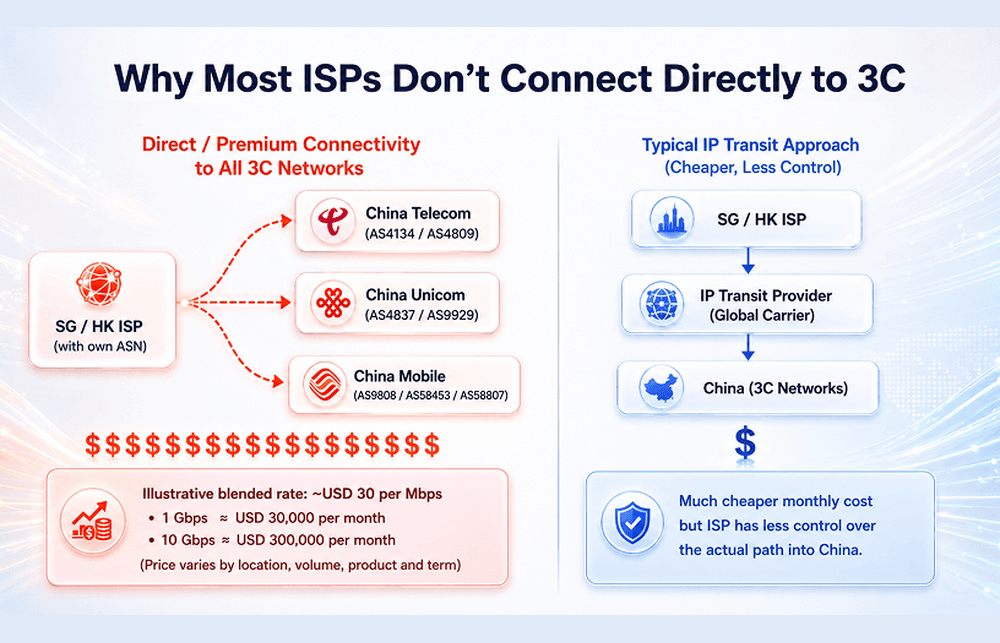
The actual number depends heavily on carrier, location, commit level, contract term and the product being purchased.
Let's simplify everything and assume a blended cost of:
US$30 per Mbps.
A 1 Gbps commit becomes:
1,000 Mbps × US$30 = US$30,000 per month.
A 10 Gbps commit becomes:
10,000 Mbps × US$30 = US$300,000 per month.
This is only the bandwidth. We haven't included your router ports, cross-connects, transport, colocation or redundancy.
Now compare that with how inexpensive ordinary IP transit has become in Singapore and Hong Kong.
You can probably understand why many providers struggle to justify the business case.
Customers want cheap Internet. They also want premium China connectivity.
Unfortunately, those two things don't always go together.
The pricing above is an illustrative example based on wholesale quotations and market experience seen by Axclusive. Actual pricing varies substantially depending on carrier, location, bandwidth commitment, product and contract term.
What Can an End User Do?
One possible solution is to improve the connectivity from the China side.
If you have an office in China, speak to the local carrier about premium Internet connectivity.
For China Telecom, the best-known example is CN2 AS4809, which China Telecom describes as its next-generation backbone and successor to ChinaNet. [4]
The idea is simple.
Instead of sending business-critical international traffic over a normal mass-market Internet service and hoping for the best, you use a service designed with better international connectivity in mind. These premium or next-generation networks are generally better interconnected internationally, particularly across major Asian hubs.
There is, however, an obvious limitation.
It only improves the connection while your staff member is using that service in the office. Once they go home and switch to residential broadband, or start using mobile data, the performance can change again.
Same laptop. Same application. Same server.
Different network. Different route.
So What Can Axclusive Do?
If you are simply looking for a faster path into China while keeping your Internet costs reasonable, this is where better routing can make a real difference.
You don't necessarily need to buy a full premium circuit from every Chinese carrier for all of your traffic.
Based on our operational experience with the China destinations we work with, the Axclusive network commonly sees latency of around 150 ms, with some destinations considerably lower at around 70 ms, while others will naturally be higher depending on the carrier, city and route.
For customers that need more consistent or application-aware connectivity into China, we also offer a China SD-WAN solution to further optimize the path and improve performance.
Frequently Asked Questions
Is 250 ms latency from Singapore to China normal?
Not necessarily, but it isn't automatically abnormal either. There's no single "latency to China" number — it depends on the destination city, which carrier (China Telecom, China Unicom or China Mobile) the destination sits behind, and how far the traffic must travel across that carrier's domestic network before and after crossing the border. China Mobile International's own published objectives put Singapore-to-mainland round-trip delay around 90 ms to its Beijing/Shanghai/Guangzhou hubs, so 250 ms is worth investigating rather than accepting as inherent to China.
Does the Great Firewall cause packet loss to China?
It can — DNS manipulation and HTTP/HTTPS filtering are documented GFW mechanisms — but it's rarely the only cause. Congestion inside China's metropolitan, provincial and national backbone networks, overloaded international gateways, and BGP routing choices made by your own ISP's transit provider frequently contribute just as much, or more.
Why is premium China connectivity so expensive?
Direct or premium connectivity into China Telecom, China Unicom and China Mobile is priced well above typical IP transit in markets like Singapore and Hong Kong — commonly in the range of US$30–60 per Mbps based on wholesale quotations, versus a fraction of that for standard international transit. That gap is why most ISPs route China traffic through general transit providers rather than buying premium circuits from all three carriers.
Does traffic from Singapore to China always take the shortest geographic route?
No. BGP route selection depends on routing policy, preference and what routes are advertised by neighbouring networks — not physical distance. A ping from Singapore to China can take a detour through another Asian hub, or even a trans-Pacific path, depending on which transit provider and interconnection your ISP is using.
What can a business do about high latency or packet loss to China?
There are a few options. A business with an office in China can purchase premium carrier-specific connectivity, such as China Telecom's CN2 or China Unicom's AS9929. Another option is to work with a transit provider like Axclusive that actively optimizes routing towards all three major Chinese carriers instead of relying only on default Internet paths.
The best approach really depends on where your users or customers are located, which carrier they are using, and how much you are prepared to spend to improve that particular route.
If your business regularly communicates between Singapore, Hong Kong and mainland China and you're experiencing high latency or packet loss, talk to us.
Axclusive can help you look at the actual route and find a better balance between China network performance and cost.
References
[1] USENIX — Measuring the Great Firewall's Multi-layered Web Filtering Apparatus
Nguyen Phong Hoang et al. Research into the Great Firewall's HTTP and HTTPS filtering mechanisms and network deployment.
[2] USENIX Security 2021 — How Great is the Great Firewall? Measuring China's DNS Censorship
Nguyen Phong Hoang et al. Detailed research into China's DNS censorship infrastructure.
URL: https://www.usenix.org/conference/usenixsecurity21/presentation/hoang
PDF: https://www.usenix.org/system/files/sec21-hoang.pdf
[3] China Unicom Global — Dedicated Internet Access
China Unicom's own description of AS4837, its more than 330 Metropolitan Area Networks in mainland China and AS9929 premium bearer network.
URL: https://kr.chinaunicomglobal.com/products-dia.php
[4] China Telecom Americas — CN2 / Global Network
China Telecom describes CN2 AS4809 as its next-generation IP/MPLS carrier network and successor to ChinaNet.
URL: https://www.ctamericas.com/company/global-network/cn2/
Additional China Telecom network page: https://www.ctamericas.com/company/global-network/
[5] China Mobile International — Specific Terms and Conditions of Sale for IP Transit and DIA Service
Current CMI terms covering AS58453, AS58807, Singapore-to-mainland-China and Hong Kong-to-mainland-China latency objectives, and packet-loss objectives.
URL: https://mainwebapi.cmi.chinamobile.com/uploads/template/20251216272c9a10af6d23e3b7c459e04e91bf4b.pdf
[6] IETF / RFC 4277 — Experience with the BGP-4 Protocol
Useful background on BGP route selection and the use of LOCAL_PREF and operator routing policy.
URL: https://www.rfc-editor.org/rfc/rfc4277
[7] Digital China / People's Posts and Telecommunications News — New International Communication Gateways
Official explanation of the July 2024 approval of six additional gateways in Kunming, Nanning, Qingdao and Haikou. Also explains that previously only nine gateways in Beijing, Shanghai and Guangzhou had international Internet services enabled.
URL: https://www.digitalchina.gov.cn/2024/xwzx/qwfb/202407/t20240715_4859378.htm